expr:class='"loading" + data:blog.mobileClass'>

Monday, July 28, 2014

Behind ABI's Crush on SABMiller

There's a lot of chatter around the industry about the possibility of ABInBev purchasing SABMiller. It's been going on for a while and many think a deal is imminent. There are those who think such a deal might be a good thing for craft beer. For good reason.

Today, ABI produces beer in something like 25 countries. That seems like a lot. But you have to recognize they are highly relevant in only a few...Canada, the U.S. Brazil and Mexico. These are mature markets where craft beer is an increasing problem and mainstream macrobrew is losing traction. In the U.S. alone, big brewers have lost 10 percent in volume over the past five years.

The purchase of SAB would give ABI access to a flock of emerging markets in Africa, Asia and Latin America, These are not havens of craft beer. If the SABMiller acquisition happens, ABI will almost certainly focus its attention on maximizing profits via layoffs, asset sales, supply chain consolidation, etc. After all, that's their version of brand building.

That kind of scenario would be nice for craft brewers. Not that it really matters. Once you get past a few acquisitions and crafty styles (Goose Island and Shock Top come to mind), it's pretty clear ABI lacks a firm commitment to craft beer. Most of its recent efforts have focused on boosting declining Bud and Michelob brands via spin-offs like Bud Light Platinum, Black Crown and the fruity 'rita beers. Yet the volume hole continues to grow.

When you look a little deeper, you realize ABI is not built to attack craft beer. I saw an interesting comment in a column written by an anonymous contributor to an industry newsletter that brought that point home. The author said essentially this: The more marketing muscle the big guys put into their craft-like brands, the more they convert mainstream consumers to craft beer. Bingo!

This is likely the biggest reason ABI wants to purchase SAB and go down the familiar road of cost cutting and consolidation. That is what they know. Trying to address the growth of craft beer by growing their own crafty brands and acquiring others is largely an alien concept. Plus, going down that road risks losing even more of their mainstream, core market share.

The scenario reminds me of a conversation I had a couple of years ago during a job interview. I had come from a company that experienced a sharp revenue drop largely because it knew how to sell its products only one way. The interviewer asked, "When you saw things going downhill, why didn't you shift to a different sales model?"

My answer was simple. The company was incapable of making any significant adjustment because it had been built to do business a particular way. Changing course would have required changing everything and that takes a lot of time, effort and expense. It wasn't feasible on any kind of realistic timeline, even if someone had wanted to do it.

And so it goes with ABI. They are built and truly good at one way of doing business. Acquiring SAB would allow them to stay in that comfort zone, lining the pockets of executives and satisfying shareholders. There are plenty of reasons why a deal for SAB won't happen, but this is one good reason it might.

Thursday, July 24, 2014

An Historic Day at the Oregon Brewers Festival

Yesterday's cool, damp opening day at the Oregon Brewers Festival was historic. Never before in the event's history has the weather refused to cooperate on this level. We've seen clouds and cool, for sure, but never steady rain and intermittent downpours. This isn't likely to happen again anytime soon, which makes yesterday historic.

The rain and cool temps didn't seem to spoil the mood. However, it was quite odd seeing an OBF crowd dressed in jackets and jeans, sporting umbrellas, and hiding out under the tents to stay dry. Everything is usually geared toward staying cool here. Not yesterday.

Festival director Art Larrance kicked things off with his standard talk and intros. He honored the contributions of the late Jack Joyce, co-founder of Rogue Brewing. Jack was to have been the grand marshal of the festival, leading the parade and tapping the ceremonial first keg. Jack's son, Brett, and Rogue head brewer, John Maier, stood in for their departed leader.

Larrance moved on, asking the crowd to pause momentarily to remember Vic Atiyeh, who, as governor, signed Oregon's Brewpub Bill into law in 1985, as well as victims of the recent airline tragedy in the Ukraine. He also introduced the visiting Dutch brewers and talked about the emerging relationship between Portland and Utrecht. Nicely done.


Getting around the festival grounds was a bit more challenging than usual due to the mud and umbrella count. Last year's switch to a smaller tent on the south side, designed to open up the area between the tent and beer taps, resulted in a wide swath of largely unoccupied ground as people sought shelter from the liquid sunshine.

It looks like the weather is returning to normal heading into the weekend, and I suspect the mess created by Wednesday's rain will be a forgotten, dried up detail by Friday. That's good news for everyone.


The beers
Like every other beer geek at the festival, I had a list of beers I hoped to try...and I got around to tasting most of them. One of the really dumb things about recommending beers is that most who do have not tasted everything these is to taste. I tasted maybe 20 beers, leaving 68 on the table. That's the say nothing of the Specialty Tent, where I tasted a single beer, which was excellent.

For hopheads, there's Ballast Point's Sculpin IPA, which is well-known around these parts. More adventurous folks are going to want to sample Heathen's Megadank, a juicy hop bomb that packs 120 IBU (without being all that bitter) and 8.2% ABV. Heathen's Rodney Stryker told me the ABV is closer to 9.0, which sounds right. Another not-to-be missed beer in the style is Central City Brewing's Red Betty. Central City, located in Surrey, B.C., puts Red Betty in the Imperial IPA category, but it's really an imperial red, I think. Malty and hoppy at the same time, and nicely balanced along the way. There's also Payette Brewing's Blood Orange IPA, which seemed to strike a nice balance between hoppy and tart.


In the "everything else" category, there are a lot of fruit beers in various styles. From that list, I enjoyed Elysian's Perfesser, a Belgian Blonde Ale fermented with plums and Brett. It features aromas and flavors of plums, figs and raisins in a medium body and is delicately tart. Logsdon's Straffe Drieling, a Belgian-style Tripel flavored with Hallertau hops and blended with organic pear juice during secondary fermentation, is excellent.

I really wanted to like Paradise Creek Brewing's Huckleberry Pucker, a flavored Berliner-Weisse. But I found the huckleberry presence overwhelming and out of balance. Others liked it, so be my guest and give it a try. If you're wondering why I wanted to like the Paradise Creek entry, it's because the brewery is located in Pullman, Wash., home of my Alma mater, Washington State University. Go Cougs!

Bottom Line
As I was sitting down to write this, I figured the weather would be improving. Then I took the Labs out for their morning run and experienced light rain. It may turn out that the shift to warmer weather is slower than predicted. We may be looking at a mushy day today followed by three warm and dry days.


If that's the way it turns out, it's going to be a busy weekend at the festival. Friday and Saturday are historically the most crowded days and the wacky weather yesterday and today will likely magnify that tendency. My advice? Get to the park early and get your fill of beers on the south side as quickly as you can. Then move to the north side, which always tends to be less populated. There are plenty of good beers on both ends, to say nothing of the Specialty Tent.

I'll be back at the festival on Friday and Saturday, and will be signing copies of my book on Portland's beer history near the south tent. Naturally, I'll be doing some additional beer sampling, as well, just to stay limber. Stop by and say hello if you're passing by.

Happy festing!


Monday, July 21, 2014

Atiyeh's Link to Oregon Craft Beer

There's a fair amount of buzz in Portland media today surrounding the passing of Vic Atiyeh, Oregon's 32nd governor. Atiyeh served two terms, from 1979 to 1987. He passed away Sunday evening due to complications from injuries suffered several weeks ago.

Atiyeh's statue at PDX
Atiyeh was governor during a difficult economic stretch for Oregon. A national recession that struck in 1980 had staying power here. The double whammy was the collapse of timber industry revenues, which had floated the state for a century.

Looking for ways to keep the state solvent, Atiyeh launched a number of economic development initiatives that eventually resulted in trade relationships around the globe. Ironically, one of his most significant moments is generally under-appreciated. Atiyeh signed the Brewpub Bill (aka SB 813) into law in 1985.

At the time, no one had a clue what the Brewpub Bill would mean to the state. Founding craft brewers thought brewpubs would provide access to an otherwise allusive clientele. They thought good beer and good food in a family environment would push the business (they hardly thought of it as an industry) to new heights.

The story of how the brewpub legislation was bounced around the Oregon Legislature is covered in my book, Portland Beer: Crafting the Road to Beervana. In looking back, I discovered the brewpub idea was not universally supported by legislators. Some were against it because politically connected beer distributors didn't like it. Others thought approving brewpubs would give Coors access to Oregon, and they didn't like Coors' politics.

The fact is, the law that legalized brewpubs probably could not have gotten through the legislature on its own due to opposition in the state senate. The way it did get through, finally, was inserted into a bill that legalized the sale of alcohol in bed and breakfast establishments. The brewpub language was added to that bill and passed out of conference committee.

There was little fanfare when the bill reached Gov. Atiyeh's desk on July 13, 1985. He signed it into law and it was filed with the Secretary of State two days later. Little did anyone know.

The Brewpub Bill did not mark the beginning of the craft beer revolution in Oregon. And Oregon wasn't the first state to pass such legislation. But brewpubs turned out to be a crucial element in what has grown into a multi-billion dollar industry. Without them, craft beer would have remained largely hidden behind the blackened windows of taverns and bars. Instead, Oregonians got to experience craft beer in the well-lit comfort of brewpubs. The rest is history, really.

As we prepare for the 27th Oregon Brewers Festival, I hope someone will take notice and remember that the Brewpub Bill became law on Atiyeh's watch. We should toast Atiyeh and those who worked so hard to pass that legislation 29 years ago. We've come a long way.

Saturday, July 19, 2014

Oregon's Biggest Craft Beer Party Returns

Next week's renewal of the Oregon Brewers Festival is arguably the highlight of beer year here. The beer scene has spawned a flood of smaller events through the year, but the OBF is the oldest and biggest. Most of those other events wouldn't even exist without the blueprint of the OBF.

So I'm always somewhat amused when I hear some of my beer geek friends beating on the OBF. Gripes take many forms. Some don't like the crowds or the atmosphere. Others aren't impressed with the beer list. Still others think the event has become too commercialized.

Look, I've been happy to complain about some of the shortcomings at the OBF. I wish they could do something about the lines. I questioned the move to a 3 oz taste last year. I frankly don't like the frat-like drinking atmosphere that descends Friday and Saturday night. I digress.

As with any large event, you have to take the good with the bad. Things are always going to be crazy when you get a lot of people together. Add excessive beer drinking and you've got a recipe for potential chaos. But I've had far more good times than bad ones at the OBF over the years.

The first OBF was held 26 years ago this month, July 1988. That makes this year's event the 27th actual festival. We've come a long way in the intervening years. As the inaugural poster below shows, that first OBF was a two-day affair. Later, they added a third day, which prompted a lot of Friday afternoons off around town. Then they went to four days, prompting full days off. Last year they added Wednesday in an effort to spread the crowds out over more days.

It isn't mentioned very often, but there has also been an evolutionary shift in what the OBF is all about. During the early years, it was mostly a chance for craft brewers to show off beers that differed from macro sludge. Today, the event is much more about beers that are unique or special even within craft beer. Many of the beers poured are brewed for the event.


Want a great example? Last year, Heathen Brewing brewed Transgression IPA specifically for the OBF. This beer requires a special dry-hopping treatment. The effort paid off in a big way, as the beer was a huge hit and won the people's choice award. It also put Heathen, which operates out of a residential garage in Vancouver, on the map. That's the power of the OBF.

There's also the economic impact. In the early years, the OBF was a far more modest affair than it is today. Announced attendance last year was 85,000. The financial benefit to the local economy is enormous, estimated at $31 million by a group that surveys attendees and analyzes the collected data. This is to say nothing of the countless spin-off festivals and events that boost Portland's bottom line.

If you need one more indicator of how popular and mainstream the OBF has become, look no further than the annual Get My Perks promotion. The special offer went live the other morning and they sold the 300 available packages in less than 10 minutes. That's a package every two seconds. Ye gods!

OBF 2014
Organizers will pour 88 beers in 30 styles from the taps near the main tents. Don't get too caught up in the style guidelines. As in recent years, there are a lot of IPAs. But fruit beers have a solid presence and some of the IPAs actually double as fruit beers. There's something for everyone. You can review the beer list here and create your own pre-fest cheat sheet.


It's worth mentioning that the Buzz Tent, which features rare and often barrel-aged beers, returns after taking last year off. They're now calling it the Specialty Tent. Expect to find some great, albeit costly beers in there. They plan to roll through more than 100 specialty beers during the course of the event. This is where you'll find the beer geek crowd.

An added attraction will be some brewers visiting from Utrecht in the Netherlands, which has a Friendship City relationship with Portland. OBF co-founder Art Larrance traveled there last year and discovered a thriving craft beer scene that reminded him of the Northwest in the 1980s. He invited a group of brewers over and several Dutch beers will be poured in the Specialty Tent. There will also be daily meet the brewer sessions. It's all part of giving the OBF more of an international flavor.

Last year's switch from the traditional plastic mug to a glass was well-received and continues. The glass is a far better tasting vessel and, coincidentally, helped obscure last year's other big change...the advent of the 3 oz pour. Three ounces in the old plastic mug would have raised some eyebrows. Three ounces in the bottom of a nicely tapered glass didn't cause much concern. Smart move.

It's the same old story with tokens and glasses. The glass will set you back $7 and tokens are $1. There are a few places selling glasses and tokens in advance: Belmont Station, Cascade Barrel House, the Raccoon Lodge, Deschutes in the Pearl, the Green Dragon and Rogue Public House. You won't save any money, but you may save time in line at the festival.

Even if some of my beer geek friends aren't especially keen on the OBF, I still think of it as the marquee craft beer event of the summer and year. There isn't a single event on the calendar that has close to the influence of the OBF. I look forward to it every year. If you're keeping track, I'll be attending Wednesday and will post findings and favorites on Thursday or Friday.

See you under the tents.

Wednesday, July 16, 2014

Pints Urban Taproom: More Than Meets the Eye

If you follow Portland's beer scene, you probably know of Pints Urban Taproom. The place has been open in Old Town since 2012. It'a a cozy little space which morphs from a morning coffee house to an afternoon and evening brewpub. But that's just the tip of the iceberg. There's a lot going on here that isn't so obvious.

My first visit to Pints happened back in early 2012, not long after they opened. Old Town isn't part of my hood and I don't get down there that often. In fact, that first visit was part of a Brewvana tour. I was impressed with the space. The beer list was solid, if not all that exciting.

Fast forward two years and things have changed quite a bit. In those early days, the beers were brewed by Zach Beckwith, who had come over from Lompoc. He was all about taking a simple, traditional approach to brewing. The mostly low- ABV beers reflected that approach.

Today, the beers are being brewed by Alan Taylor, who has a distinguished brewing background I'll delve into in due time. Taylor replaced Patrick Watkins, who had replaced Beckwith when the latter left for Three Creeks. These are wild times in craft beer.

The story of how Taylor became involved in Pints is a bit trickier than it appears. He began working for owner Chad Rennaker's ZH Brewing in 2010, but not on the Pints project. A local consultant was coordinating Pints. Taylor was hired to provide brewing expertise on several projects Rennaker had in motion at the time, most notably one in Albuquerque.


"Chad's 'real job' is real estate development, with an emphasis on mixed-use/mixed-rate concepts," says Taylor. "He wants his buildings to have a brewery-restaurant on the main floor. The Albuquerque project was the big reason we partnered up. He needed an experienced brewer/brewmaster to start up, hire, and supervise his projects. I was the right fit."

Albuquerque isn't all. For the past several years, Rennaker has been working with the Portland Development Commission on putting a brewpub in Southeast Portland's downtrodden Lents neighborhood. The PDC believes a brewpub will help revitalize the area and is financially committed to making it happen (more here).


"The Lents project has been running in the background since I started here," Taylor said. "It has moved forward and we now hope to be open early next year. In-house we will have a number of NW-style beers and a mixed American/Central European beer and food menu. We also hope to do packaged sales [probably bottles] focused on German styles." 

So Pints is actually one piece of a larger picture that includes Albuquerque and Lents. Phoenix is reportedly the next place Rennaker and Taylor are focused on. Taylor stays busy with big picture projects and his brewing duties at Pints. His employment is secure.


Getting back to Taylor's brewing background, it is extensive. He did time at Full Sail, Spanish Peaks, Gordon-Biersch and Widmer. He also worked as a Brewmaster and general manager of a brauhaus in Germany. Each of these stops happened after he received formal brewing training in Berlin. 

"My time in Germany doesn't take up that much space on my resume, but it was instrumental in my understanding and appreciation of brewing techniques," he said. "School was great and my times in Berlin and Bavaria were eye-opening and true fun."


The beers at Pints today reflect Taylor's background. Alongside a rich line-up of Northwest-influenced beers (Brickhouse Blonde, Seismic IPA, Rip Saw Red, Steel Bridge Stout measure up nicely) you'll find Konvention Kosch, Helles Lager, as well as the excellent Amerikaner Berliner-Weisse. 

Green Line Organic Pale Ale, named for the MAX line in Old Town, was featured at the recent North American Organic Brewers Festival. An organic version of the Berliner-Weisse, expected to be ready for the event and eagerly anticipated by many, was not quite ready, Taylor says. Mystery solved.


Given Taylor's role in the larger project work at ZH Brewing, you wonder how long he will be able to stay in the role of brewer. He has brewed 224 batches on a 3.5 bbl, mostly manual system since he arrived at Pints in April 2013. He knows he can't keep it up forever with all he has on his plate.

"I'm realistic. I can barely keep up with Pints production, let alone run multiple systems in multiple locations. Once Lents is squared away, I'll need someone to assist with beer production. That person will work with me on both systems to utilize the strengths of each.  As we grow, we'll add boots when and where needed and I'll pull back from day-to-day brewing in order to focus on the big picture."

In keeping with that theme, Taylor routinely invites Pints bar staff into the brewery to assist with recipe development and tweaking. Staff involvement and training helps keep things fresh in the brewery and is the lifeblood of a successful, evolving brewery, he says. 

What Rennaker and Taylor are doing with Pints and the related projects is just a new twist on an old theme. The combination of good beer and food is a proven winner almost anywhere. Look around. There's an entire industry that is built largely on that premise. And it continues to grow.

Tuesday, July 8, 2014

Baseball, Apple Pie, Beer Machines

If you pay attention to sports news, you may have heard about the self-serve DraftServ beer stations that will be in use at next week's All-Star game in Minnesota. The machines are the handiwork of a partnership between concessionaire Delaware North and, you guessed it, Anheuser-Busch.

The way it works is simple. Fans show their ID and then purchase a beer card in the amount they want...$10, $20, etc. There will reportedly be a $50 card at the All-Star game. To get a beer or beers, the fan goes to the DraftServ machine, scans the preloaded card and chooses one of several beers and the size of the pour.

There's a bit of a downside to this arrangement when you see the list of beers. Bud, Bud Light, Shock Top Lemon Shandy and Goose Island 312 Urban Pale Ale. These are obviously lowest common denominator beers, meant to sooth the pallets of novice beer fans.

Price is another thing. Fans will pay 38-40 cents an ounce for the available sludge. That translates to nearly $5 for a 12 oz glass of Shock Top or Goose Island, a little less for Bud and Bud Light. Those are horrible prices almost anywhere, but not in a Major League ballpark. The machines have a governor that limits fans to 48 ounces of beer every 15 minutes. That seems like a lot to me, but never mind.

The DraftServ machines reduce labor costs, for sure. Someone still has to check ID and collect funds for the cards. And someone has to monitor the area around the machines to make sure minors and drunks don't have access to the beer. But they will generally reduce the cost of serving beer, it seems.

I'm somewhat ambivalent about these machines. I suppose they're the wave of the future as ballparks outsource concessions to corporate efficiency experts. Reducing labor costs is one of the few ways they can boost profits while expanding food and drink options.

These machines have potential. They might offer a way for sports and other venues to sell a wide selection of good beer without a lot of fuss. Imagine two or three of these things lined up and filled with good craft beer. And no Bud Light. Sounds pretty good, huh?

Of course, that's probably a pipe dream, given who's involved in this project. Fans are likely to be saddled with standard issue Anheuser-Busch swill, which makes DraftServ a great idea with apparently nowhere to go. Too bad.

Thursday, July 3, 2014

Soulless Thugs at Work in Natty Greene's Patent Case

The upcoming Fourth of July celebration, otherwise known as national war zone weekend, is going to be great for the beer industry. A whole lot of beer is going to be bought and guzzled this weekend. And we all know massive beer consumption and fireworks go perfectly well together. Boom!

Just in time for the holiday, I came across news that our old friend, Anheuser-Busch, is continuing its ongoing attack on the craft beer industry. This time out, the St. Louis thugs are attempting to block a trademark application filed by Natty Greene's Brewing of Greensboro, N.C.

Natty Greene's, founded in 2004, has been growing steadily and now produces about 17,000 barrels of beer annually. Owners filed the application to patent the phrase "Natty Greene's" because they recently expanded distribution outside the state of North Carolina. Now seemed a good time to protect the name.

In case you're wondering, and you should wonder, Natty Greene's is named after Nathaniel Greene, a general during the American Revolutionary War (no, kids, that's not the one that started when the Germans bombed Pearl Harbor). A number of American cities, including Greensboro, are also named after Greene, the general.


Anheuser-Busch, which owns dubious trademarks on Natty Light, Fatty Natty and Fatty Daddy in connection with its Natural Light brand, claims that granting Natty Greene's application would damage or dilute the value of the Natty family.

Let's take a look at that claim. How do you damage a brand like Natural Light? The beer has been part of the Anheuser-Busch line since 1977, when it was rushed to market in response to the wild popularity of Miller Lite. AB had to do something. Bud Light, you may recall, came later.


Natural Light or Natty Light or whatever you want to call it is a sub-premium brand, typically sold at discount prices where you can find it. It has a good following on some college campuses because it's cheap and frat boys can drink a lot of it before they puke or pass out. It's also popular in poverty-stricken urban ghettos for similar reasons. But never mind.

The thing is, if someone is going to be damaged by way of name association, it will almost certainly be Natty Greene's. Some people outside North Carolina might see the name and immediately connect it with Natty Light or one of the other Nattys. Natty Greene's is a respectable craft brand. They are the ones risking damage or dilution of value.


Natty Greene's co-founder Kayne Fisher characterizes AB's opposition as a nuisance filing. He has a hard time seeing how anyone is going to confuse Natty Greene's with any of the Natty-related trademarks. He has a point. He brews a good product. Natty Light is another animal.

We'll have to wait and see what happens in court. Fisher expects to move ahead with the patent application. Anheuser-Busch, with the deepest pockets in the industry, is not going to drop its opposition and can easily afford to extend the proceedings. Soulless thugs never quit.


Sunday, June 29, 2014

The Continuing Dishonesty of the Shaker Pint

There are some pretty amusing and supple justifications for the shaker pint glass. It stacks nicely. It's durable. It's easy to clean. It's cheap. Do a Google search if you want to learn all about why it's a great idea for bars and pubs to use the shaker pint, aka cheater pint.

 A 12 oz beer in a cheater/shaker pint
Of course, there are also plenty of arguments against the popular glass. It's a rather poor piece of glassware if you want to experience the full flavor and aroma of most beers, for example. Again, do a Google search if you want to learn more.

In fact, the primary argument against the shaker pint is simple: It isn't a pint at all. Seriously. Try pouring a pint of beer into a shaker pint. Do yourself a favor and stand near a sink when you're doing it. Because a pint of beer won't fit in a shaker glass. Sorry.

In a quick home experiment, I found a 12 oz bottle of beer fit nicely into a shaker pint glass. The reason is head or foam. Your beer needs it and the shaker pint glass can't accommodate the beer and the head. In fact, the average shaker pour in a pub is probably 12-13 ounces.

There's no law against serving patrons less than a pint of beer and calling it a pint. Thanks in part to the Honest Pint Project, started by Jeff Alworth in 2007, a number of bars and pubs upgraded their glassware to something that accommodates a pint of beer with head. An effort to enforce a 16-ounce pint rule through legislation failed.

A number of establishments were certified as serving an Honest Pint as part of the project. You can still see a list of certified places on the website, although Jeff abandoned the HPP in 2011. The part of the site where you could submit info to certify a pub has gone dark, as Jeff said it would.

I'm not going to get into an analysis of why some places continue to use the shaker pint. It's pretty obvious that pouring short pints means more pints per gallon, keg or serving tank. There's an economic incentive to use these glasses, beyond the simple fact that they're cheap.

But it seems to me that we ought to receive a proper pint of beer when that's what we order. I can't imagine the justification for representing something as a pint and then delivering something less than that. "Dishonest" is one word that comes to mind.

Frankly, it's hard to believe cheater/shaker pint glasses are still around in significant numbers. They need to go.

Thursday, June 26, 2014

NAOBF Overcomes Soggy Opening Day

If you attend enough summer beer festivals in Oregon, sooner or later you're going to get wet. Such was the case for opening day of the 2014 North American Organic Beer Festival at Overlook Park. The rain simply refused to go away. Those in attendance were not deterred.

As I was saying to some friends as we worked our way through beers and homemade bread-sticks, getting a little wet at a summer festival is something you have to experience. I could have postponed my visit to the weekend, when the weather is expected to be better. But I wanted to experience the event in the rain. Call me crazy.

The crowd was small on Thursday. The event expanded to four days last year and I suspect it would have been fairly busy by late afternoon had it not been for the weather. Beer fans usually pick up on an additional day by the second or third year.

For anyone worried about the rain, there are plenty of places to hide. When the rain started coming down heavier at one point, virtually everyone hanging around near the beer taps moved under cover. Pretty funny. There's also a large tent with tables and chairs where they have several flat screen TVs showing soccer or whatever. It's a nice arrangement.


The big shade tree that lives just beyond the entry gate is back in action. Last year, you may recall, the area under the tree had to be abandoned during hot weather due to a cracked limb. It's pretty plain to see where that amputated limb once grew.

There are plenty of good beers to be had. From my brief cheat-sheet, the Ambacht G++ was excellent, just as it was last year. I reckon it was worth the double token price. Hopworks Totally Radler tasted great even on a cool, damp day. I had targeted Pints Bio-Liner Weisse, but it was not present, and may not be for the duration due to some sort of mix-up. I settled for their Green Line Pale Ale, a light and crisp little mistress. There were many more.


One thing you need to be aware of is they have gone to a 3 ounce taste this year. It had been 4 ounces in the past and the press materials said that would be the case this year. Not so. They appear to be following the lead of the Oregon Brewers Festival and others with the change. There's not much you can do about it, but I do suggest avoiding the double token beers. At one token, you are paying the equivalent of $4 for a 12 oz beer. At two tokens, you're paying $8 for that same beer. It's a little steep.

Looking ahead, I suspect this is the last year the NAOBF will be held in June. They've simply had it with the unpredictable weather. Last year they had cool followed by hot. This year, rain. It gets a little old hoping and praying for good weather and getting mixed results. And we all know Oregon weather tends to be better and more predictable after the Fourth of July.


Next year's event will likely move into July and may change venues, as well. Nothing is certain, yet. Look, it's great to have an event that allows attendees to get there by public transit or bike. But there's very little parking, which discourages folks who have to come by car. And you really need to make your event easily accessible to all potential comers.

As for this year, the forecast had been suggesting the weekend weather would be better than Thursday or Friday. Now it looks a little dicey. I don't really see why that should be a problem for beer fans. As noted, there's plenty of shelter...and what's a little rain, anyway? This is Oregon!

Friday, June 20, 2014

Summer Festival Blitz Ramps Up with NAOBF

We have entered the festival twilight zone, otherwise known as summer in Oregon. Between now and late September, there will be some kind of outdoor event happening virtually every weekend. In other words, it's a great time of year.

Next week's North American Organic Brewers Festival has established itself as one of the premier outdoor events of the summer. That's a difficult hill to climb for any June event because the weather often refuses to cooperate. Yet the NAOBF has been successful. So successful that they expanded to four days last year.  Dates are June 26-29. The venue is  Overlook Park, a great spot.

The NAOBF puts a lot of effort into advancing sustainable values, and  not just with the beer.  The festival glass/cup is made from compostable cornstarch . Electricity comes from biodiesel generators. Overlook Park works nicely because it is conveniently located on public transit lines (MAX and buses), as well as bike routes. A bike corral, sponsored by Hopworks, will be in action.

Almost everything gets recycled here. Food vendors use compostable plates and utensils. The event generated 171 lbs of trash last year, down from 175 lbs the year before, when it ran only three days. Not bad. Just as important, NAOBF values have rubbed off on many other festivals, which have implemented recycling programs and other earth-friendly measures.


Organic beer has been gaining in popularity over the last 10 or so years. For 2013, sales increased by $79 million, according to the NAOBF press release. That suggests brewers and beer consumers are increasingly comfortable and committed to organic beer. That's good news for the planet, as the production of  organic ingredients is less damaging to the environment.

The NAOBF goes back to 2003, when it was founded by Craig Nicholls, the founding father of organic brewing in Portland. Nicholls worked at Alameda Brewing on Fremont and later at Halling Brewing in Gresham before opening the now defunct Roots Organic Brewing in 2005. The NAOBF took a couple of years off while Nicholls worked on Roots, then returned in 2006. It moved to its current location in 2007.


There are 40 breweries/cideries pouring liquid sunshine at this year's NAOBF. You can view the full list on the event website here. Not all of the brews are 100 percent organic, but all are made primarily from organic ingredients. Like always, I'll be hunting for beers that aren't commonly available around town...and they won't be hard to find. My partial hit list:

Ambacht Brewing Hillsboro, OR - G++ Ale | Belgian Strong Golden 8.5% ABV, 18 IBU
Aged in whiskey barrels previously used by Hair of the Dog to age Cherry Adam. The beer is heavily influenced by cherries the Dog left in the barrels. This was my favorite last year and I'll be more than happy to consume it again. It's one of the double token beers that's worth it.

Pints Brewing Portland, OR - Bio-Liner Weisse 2.8% ABV, 0 IBU
A traditional Berliner-Weisse brewed with organic German malts and with yeast and bacteria brought to Portland by Pints brewmaster Alan Taylor, who got his brewing training in Berlin. This is a tart bomb, as opposed to a hops bomb. Can't wait.


Reverend Nats Portland, OR - Overlook Organic Heirloom (cider) 8.6% ABV, 0 IBU
Reverend Nats makes some of the best cider around. This one leans on a blend of organic apples and is lightly sweetened with local honey. This cider was created specifically for the NAOBF. It's reportedly an "off-dry" cider free of cloying sweetness. Sounds pretty good.

Hopworks Portland, OR - Totally Radler 3.5% ABV, 21 IBU
One of the more popular entries last year, this beer is 70 percent Hopworks Organic Lager and 30 percent organic lemonade. The result is a crisp, refreshing and highly drinkable beer. If it gets hot, you won't even have to search for this one...just look for the longest line.

That's just a partial list. I expect to attend Thursday afternoon and file an updated report Friday morning. That report will include a short list of new discoveries. 

If you're wondering, festival hours are noon to 9 p.m. Thursday through Saturday, noon to 5 p.m. Sunday. As with virtually all of these events, I suggest arriving early for the best selection and shortest lines. I suspect Friday and Saturday will see crowds, but you never know. There's a lot more information on the event website here.

Tuesday, June 17, 2014

Paying the Cost to be the Boss

Craft beer pricing is one of those things that is constantly in the back of my mind. It's almost comical to watch the increasing demand for rare and "special" beers produce prices that are in some ways totally insane. If enough people chase these beers, escalating prices are the result.

I was first looking at price strictly from the standpoint of retail packaging vs. growlers. There are some fairly wacky things going on there, as you will see. The best and worst deals aren't necessarily what many think. Then I took a look at festival pricing, which is home to some true insanity.

Bottles and Growlers
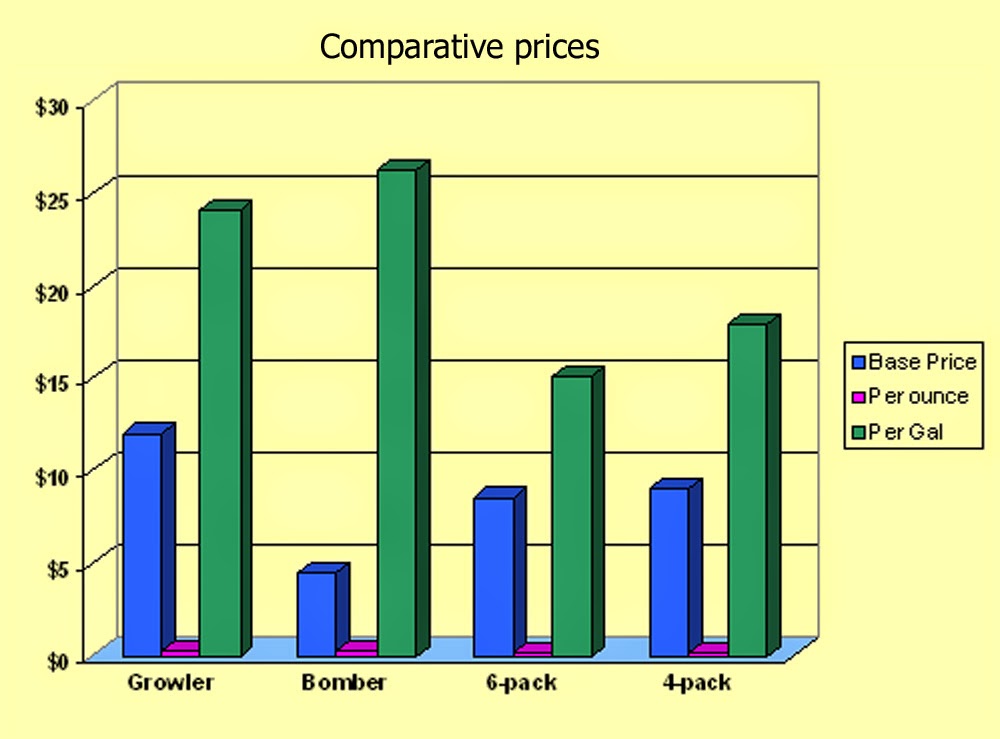
A few notes on pricing. I came up with some averages for the various forms of packaged beer. For growlers, I used $12. For 22 oz bombers, $4.50. For six-packs of 12 oz bottles, $8.50. For four-packs of 16 oz cans, $9. There are certainly prices above and below those values. If anything, I think my averages are probably on the low end.

Looking at the graph, it's pretty evident that 22 oz bombers are the worse packaged deal around. Growlers are a close second. Six-packs are easily the best deal. The obvious argument for bombers and growlers is that you often can't buy those beers in smaller bottles or cans. Fine.


I have little problem with those who are willing to pay a premium for a beer that can only be had by growler or bomber. Go for it! What doesn't make any sense at all is getting a growler fill or buying a 22 oz bottle of something you can get in a six-pack. You're wasting money.

The high price of growlers suggests they are tied to pint pricing. Indeed, pints bought in a pub (average price of $4.50) are a worse deal than growlers or bombers by more than 10 cents an ounce. I suppose this is related to the overhead associated with serving that pint. There's some of that with growlers, as well, but they look like a bargain next to pints.


Something to keep in mind with respect to pub pints is the glass. I used a value of 15 ounces, to account for foam in a pint glass. But most watering holes use shaker pint glasses for beer. These things hold 14 ounces, at best. A little foam on top turns that pint you just ordered into 12-13 ounces, which bumps up the cost per ounce and gallon. So my numbers are generous.

Festival prices
Summer is festival season and summer is here, more or less. There are several large events on the docket and numerous smaller ones. Tasting costs have increased in the last couple of years, almost in concert with the blitzkrieg schedule. Growing demand apparently means higher prices.

A few years ago, most festivals offered a 4 oz taste for $1 in cash or script. Within the last year or so, they have mostly gone to a 3 oz taste for the same money. Even that is a bit deceiving due to the escalating number of "special" beers that require two, three or four tokens for a taste. Seriously.


The standard 3 oz festival taste is a marginally worse deal than a pub pint (33 vs 30 cents an ounce). Of course, you may be tasting something reasonably unique and you might be tasting it in a unique setting. So you can't get too excited about the cost difference.

The double token taste makes matters significantly worse. Now your per ounce cost has jumped to 66 cents, $84 a gallon. Folks who think gas prices are high evidently never heard of beer festival pricing. The only plausible scenario in which the double token taste makes sense is something truly special. And then barely.


The three token taste, which I've already seen and will certainly see more of this summer, is truly offensive. Your cost per ounce has now reached $1 and the cost per gallon has risen to $128. Let's hope OPEC doesn't hear about this.

The four token taste...well, never mind.

If you take festival prices and extrapolate the numbers to keg price, the numbers are astounding. The standard taste yields a keg price of $650. The double token taste keg would be worth $1,300. The triple token keg would be $1,980. The four token keg, $2,640. These prices are for standard half barrels, and most of these "special" beers are poured from smaller kegs. Still, you get the idea.


I was telling some friends at a recent festival to avoid the multiple token beers.They didn't and there was a bit of buyers remorse. Hey, it's your money and you get to decide how to spend it. But there aren't many beers worth two, three or four tokens and the associated price per ounce, gallon and keg. In fact, these numbers are fairly shocking.

The organizers dreaming up these prices have a great sense of humor, I think. They know they can do whatever they want as long as there are hoards of fans who want "special" beers and don't mind "Paying the Cost to be the Boss." And so it goes. With apologies to B.B. King.