expr:class='"loading" + data:blog.mobileClass'>

Sunday, March 20, 2016

Mastering the Art of Sport Drinking

One of the worst kept secrets in beer is the emergence the specialized, sport drinker. The sport drinker is much more than a legend in his/her own mind. Indeed, these individuals have been instrumental in propping up a new kind of beer establishment.

What is sport drinking? It's the art of collecting as many beer pelts as possible during any and all drinking sessions. Folks engaged in this sport usually don't care about quaffing mass quantities of any particular beer. Instead, they chase smaller servings of many beers.

Even in beer-centric Portland, that represents a fairly dramatic change from earlier times, when folks visited breweries and brewpubs to enjoy a pitcher or pints of a favored beer. There was no real hunt for specialty beers, no desire to seek out variety. People drank what they liked and called it good.

Of course, that scenario is still in play. Plenty of folks go to breweries and brewpubs and drink pitchers and pints in what might be best-described as an entry-level craft beer experience. Because there are more casual beer fans than serious beer geeks, the best breweries and brewpubs continue to flourish.

But the evolving, maturing beer culture is producing a growing number of sport drinkers, who existed in previous times only in small numbers. These folks demand special beers. Local beers, no matter how good, aren't enough. They want stuff from outside the city and state. The result of that growing demand is the eccentric beer bar.

Some of our notable local destinations include APEX, Beermongers, Belmont Station, Baileys/Upper Lip, Bridgetown Beerhouse, The Imperial Bottleshop, Roscoe's and Tin Bucket. But that's only a fraction of the possible list because there are countless places that feature extensive tap lists and don't quite fall into the beer bar category.

"These bars fill an important niche," an industry source tells me. "They showcase beers from far flung breweries like Barley Brown's and Arch Rock, which many Portlanders would never have heard of otherwise. They also provide a sense of what's happening across Oregon without driving to Bend, Hood River, Eugene and the coast."

I have to admit I'm far more likely to visit a beer bar than a brewery. I enjoy the variety. The downside for many is the snobbishness that's sometimes part of the deal. Beer bars can be intimidating places for casual drinkers, which is shameful and needs to change.

By the way, it turns out sport drinking and beer bars are nearly a perfect fit. We just learned via a Brewers Association article that the smaller pours generally preferred by sport drinkers actually deliver higher profits per keg to bars  Go figure.

Where do were go from here? Honestly, who knows. Portland's maturing, evolving beer scene presents creative entrepreneurs with a nearly endless array of opportunities. We've passed the point where you need to own or operate a brewery to tap into the beer economy. There are alternatives.

Those who have mastered or are mastering the art of sport drinking can be proud.

Monday, March 14, 2016

Belmont Station's 19th Anniversary Bash Thursday

Thursday is St. Patty's Day, the universal opportunity to drink too much while celebrating Irish history. Or something like that. Coincidentally, it's also Belmont Station's birthday. And they're having a party featuring some pretty great beers to mark the day. More on that in a bit.

In case you don't know, Belmont Station is the oldest beer bar in Portland. Like the original Bridgeport Brewpub, which set the standard by which all brewpubs here were measured, Belmont Station set the standard for beer bars. Though it wasn't always that.

When it opened in a small space next to the Horse Brass in 1997, Belmont Station was sort of a clearinghouse for novelty items from the UK. They had beer, too, but no bar.

"From what I remember, the Horse Brass used to import eclectic English food items and sell them to customers, in addition to using them in the bar," says Chris Ormand, who joined the Belmont Station crew in 2005 and is currently the beer buyer.

"At some point, the bartenders got tired of taking time away from serving beer to run into the supply room and grab stuff for customers. Someone suggested to Don [Younger] that they take over the empty spot across the hall and use it as a retail outlet. That was the beginning."

I have to admit that I did not frequent that location. I stopped in a few times and found an odd mix of merchandise: pint glasses, tin signs, English candy bars, bar towels, VHS tapes of classic British comedies, etc.. They carried a few hundred bottles of beer. Nothing like now.

"We displayed a bottle of each beer on the shelf with a price tag," Ormand recalls. "The actual beer was stored in giant walk-ins. Customers would make a list of what they wanted and hand it to the cashier, who would retrieve the beer. It wasn't efficient, but the storage conditions were ideal."

New look shelves
By 2006, the old space was getting cramped. The opportunity to move to a larger space a few blocks away presented itself when a gent who owned a convenience store on Stark announced that he wished to retire. That space would become Belmont Station's new home.

"We packed up and moved to Stark in early 2007," Ormand says. "We closed the old location on the last day of 2006 and opened on Stark several days later. The bar needed extra work and didn't actually open until April 2007."

In fact, the biercafe was operated in a haphazard way for several years. They had a limited number of taps and offered a menu of sandwiches made behind the bar. It was wildly inefficient and the place wasn't all that inviting. The biercafe was definitely a work in progress.

I give Lisa Morrison a lot of credit for smoothing things out and shifting things into high gear. She acquired a controlling interest in 2013 and almost immediately dumped the sandwich-making gig. Then she added a food cart and installed additional taps.

Also available
"When I started, my focus was the biercafe, which I always felt was a sort of afterthought," she recalls. "Adding the food cart made it easier for us to focus on what we do best...beer! I like to think our recent "best beer bar" accolades are the result of that sharpening in focus."

Of course, Morrison refuses to accept all the credit. She reminded me that co-owner Carl Singmaster had a role in the decisions and that the staff at the Station contributes a lot to the success it is today. Pretty typical response from someone who is always willing to share kudos.

Anyway, to celebrate 19 years of ecstasy and great beer, each member of the staff picked a beer to share with the public during the party. The beer list, although not quite finalized, is pretty damned stellar and something no self-respecting beer fan will want to miss. It includes:
  • Schlenkerla Helles
  • de Garde Vin Lee
  • Upright Heart's Beat
  • pFriem Flanders Red
  • Piraat Triple Hop
  • Sierra Nevada Torpedo IPA
  • Block 15 Intergalactic Hop Shop Imperial IPA
  • Deschutes The Abyss 2015
  • Ecliptic Deimos Imperial Red
  • Ruse Multibeast Brandy Barrel-aged Brett Saison
  • Hair of the Dog Flanders Fred
  • Lagunitas One Hitter Imperial Stout 
  • Fremont BBomb
  • 3 Magnets Hoppy Porter
  • De Garre Tripel
  • Ecliptic/Belmont Station 19th Anniversary Barrel-aged Barleywine
The birthday bash gets underway at 3 p.m. and runs to 11:00. There's a pretty good chance some, perhaps many, of these beers are going to be limited and won't last long. St Patty's Day luck of the Irish isn't going to keep the complete list pouring forever. Arrive early for best results.

Thursday, March 10, 2016

CBA Rides Kona Growth Wave into the Future

Sometimes, perhaps often, it's better to be lucky than good. And maybe the Craft Brew Alliance was lucky when it bought Kona Brewing in 2010. Or maybe that purchase was part of a well-informed, ingenious plan that has worked out especially well for them.

Because it turns out that Kona has stepped to the forefront of the CBA's brand portfolio. After accounting for just 20 percent of CBA sales early on, Kona now accounts for 45 percent of the mix, up 17 percent in volume over the last year. It is the dominant CBA brand.

Recall that, prior to being purchased by the CBA, Kona was contract brewed by Widmer and Redhook for a number of years. Part of this was a tax dodge, a way around Hawaii's draconian tax on empty bottles shipped to the islands. It was also a way to more easily market Kona on the mainland.

With the coming of CBA ownership, Kona gained full access to the Anheuser-Busch distribution network. As you likely know, AB owns roughly a third of the CBA and has worked diligently to market its brands domestically and internationally. For Kona, the arrangement changed everything.

Access to the AB network essentially drove Kona into hyper growth, despite the beers being arguably the softest and least distinctive in the CBA portfolio. The year-round beers include Longboard Island Lager, Big Wave Golden Ale, Fire Rock Pale Ale and Castaway IPA. Nothing too exciting.

One may rightfully wonder how Kona could rise to the top of the CBA heap, which includes some vaguely distinctive Widmer beers, alongside a covey of less than stellar Redhook stuff. The answer, in my mind, is image. Kona is connected to place in much the same way Corona is. Kona is much better beer than Corona, but they both lean heavily on connection to place in their marketing. Constellation will do something similar with Ballast Point.

There's more, of course. These Kona beers, particularly top-selling Longboard and Big Wave, have caught on in a lot of places precisely because they aren't all that distinctive or aggressive. Kona is proof that, when you want to appeal to a broad consumer audience, mundane isn't such a bad thing. And maybe Kona's connection to place works well with drab.

An interesting twist involves where Kona is brewed. Most consumers assume they're drinking a Hawaiian product. That's far less the case than many realize. The bottle tax means bottled Kona is produced on the mainland, even for the Hawaiian market. That's less true with draft beer, at least some of which is produced in Hawaii for that market. The situation may be changing with the expansion of Kona's facility on the Big Island and other developments on the islands.

Regardless, the CBA is hitching its wagon to Kona and counting on the brand to pull it into the future. You can't blame them. When you have a winner, whether you got it by luck or via a proactive plan, you might as well ride it for as long and as far as you can. Kona is the little engine that could...or can, if things work out for the CBA.

Wednesday, March 9, 2016

Baker's Dozen Fest to Feature Main Food Groups

The 2nd Annual Baker's Dozen Festival will feature three of America's most favored food groups: beer, coffee and donuts. It's happening Saturday at Culmination Brewing and you need to get your ticket now if you hope to attend.

The $24 ticket includes a souvenir tasting glass, samples of 13 coffee-influenced beers and 13 donuts, plus coffee if you need it. It doesn't get much better. They'll also have live music and attendees can purchase house-made breakfast sandwiches and drinks. New this year is a donut decoration station for the kiddies.

The Beer List
Baerlic Primeval Knievel brown
Coalition Morning Sesh session
Culmination Coffee Mild
Deschutes Nitro Baltic Porter
Ecliptic Cosmic coffee IPA
Great Notion Double Stack
Labrewatory Napoleonic
McMenamins Mathonwy's Coffee Stout
Modern Times Black House stout
Melvin Coffee Murphy porter
Old Town Warp Speed coffee pale ale
Stung Caffe mead (Caffe Umbria)
Unicorn/John Lovegrove BadBeard's Coffee Milk Stout

The Donut List
Blue Star Donuts, Raspberry Rosemary,
Coco Donuts, Hole in the Dark, (chocolate cake donut hole with espresso)
Delicious Donuts Apple Fritter, 
Donut Byte Labs, “French Toast” mini doughnut
Donut-o-rama, crème brulee, minis
Joe’s Donuts, Cronut, (Yes, from all the way out in Sandy!!!)
Pip’s Mobile Doughnuts & Chai, Honey & Sea Salt, (Yes, truck on site)
Rocking Frog Café, Cinnamon Cake, 
Staccato Gelato, Ginger-Mead doughnut hole with Stung mead, 
Tonalli’s Doughnuts & Cream, Chocolate Banana Buttermilk Bar, 
Tulip Bakery, Marionberry Fritter

Organizers tell me at least 300 of the 400 available tickets are already sold. The 150 folks who bought tickets at the door last year won't be able to do that this time around. So plan ahead and purchase tickets on the event site here. 

Update (3/10/16): This event is sold out. There will be no tickets at the door.

Saturday, March 5, 2016

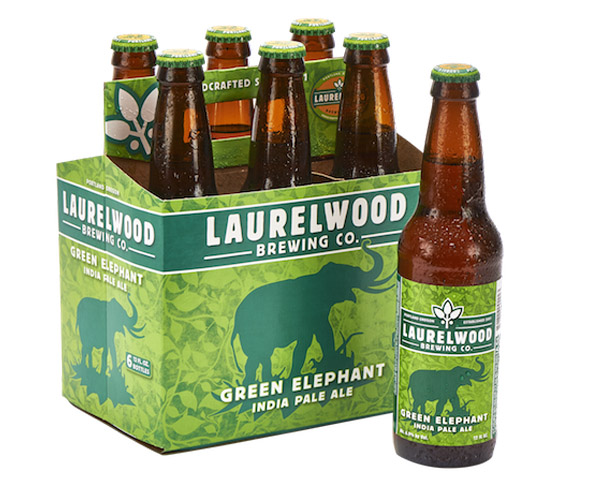
Laurelwood Releases Green Elephant Sixers

As it transitions its production brewing program to Full Sail in Hood River, Laurelwood has released Green Elephant IPA in six-packs for the first time. The popular beer had previously been available only on draft and in 22 oz bottles.

Green Elephant will join Laurelwood flagship Workhorse and Free Range Red in bottles and Red Elephant IRA in cans. It represents their second seasonal six-pack, replacing Vinter Warmer, which was available November through February.

Recall my earlier story announcing Laurelwood's move from the CBA's Woodinville facility to Hood River. That change came about because the CBA said it wanted out of the contract brewing business. Subsequently, we learned the Woodinville brewery has been leased to Pabst, which has an option to buy it within three years. 

The move to Full Sail is not quite complete. Laurelwood founder Mike De Kalb expects to be up and running at full speed in Hood River in a few weeks. If you refer to my earlier story, you'll see that timing corresponds with his estimate of spring 2016. But there have been delays

"The transition took a little longer than I had hoped, largely because we were waiting for TTB approval," De Kalb said. "But it's going well and I expect we'll be fully brewing in Hood River by the beginning of April."

So where are the current six-packs of Green Elephant coming from? Sometimes you do what you have to to hold onto precious shelf space in key accounts.

"These first two six-pack batches of Green Elephant were brewed at our Portland brewery and bottled by a mobile bottler," De Kalb said. "We did it to keep our seasonal six-pack slot in area Fred Meyer stores. That beer will just barely keep those stores supplied for a month."

Fans can expect to see the beer at Freddy's in coming days, but probably not anywhere else for a few weeks. They brewed a double batch of Workhorse and Green Elephant this past week at Full Sail. That beer will be bottled in two weeks and will help fully fill the supply pipeline.

Green Elephant IPA, if you don't know, has been a favorite of hopheads since it appeared in 2003. It features brilliant pine, floral and citrus hop notes. It may be the first of a number of special releases in 2016, as the Full Sail arrangement gains momentum.

“We have some exciting releases planned this year and Laurelwood fans can expect to see more of our beer in six-packs,” marketing director James Buxman said in a press release announcing the Green Elephant launch.

Tuesday, March 1, 2016

Messing with the OLCC's Chunk of Cheese

As a  youngster, my dad constantly reminded me that any job worth doing was worth doing right. He was an old school pain in the ass that way. His thinking typically came into play when we were working on a project where shortcuts would cheapen or ruin the completed task.

I was reminded of that ancient thinking as I looked at some OLCC numbers the other day. The task at hand was a look at which breweries showed the greatest year over year sales increase for 2015. An industry contact provided me with a comparative spreadsheet, so my job was pretty simple.

As I've mentioned before when referencing OLCC beer reports, they provide a woefully insufficient peek at what's happening in the industry. These reports, which track taxable barrels on a monthly basis, are like a chunk of Swiss cheese...full of holes.

The reports track barrels produced and sold in Oregon. Beer produced here and exported out-of-state isn't tracked. Beer produced outside Oregon and brought in also isn't tracked, although taxes are paid on those barrels by distributors.

In fact, distributors pay the bulk of barrel taxes in the state. "It's a lot easier for the state to collect taxes from 20 or 30 distributors than it is for them to track more than 200 breweries," an industry source says. "Breweries pay the taxes on beer they sell in their pubs or self-distribute. Otherwise, it's generally the distributor paying."

One of the interesting things that jumps out in the December 2015 report (these reports are always a few months behind) is that the Craft Brew Alliance (Widmer, Kona, Redhook) sold only 72 barrels in Oregon during the month. That's a 32,000 barrel decrease from 2014. What?

I figured this must be related to the renovation of brewing facilities here in Portland. Not exactly, apparently. A Widmer source says they now transfer their beer to offsite storage before it goes to distributors. But the OLCC only tracks beer that does directly from brewery to distributor. Beer that goes from offsite storage to distributors isn't tracked. 

Does anyone think that beer isn't taxed? Please. There's no way the state isn't collecting tax on that beer. The fact that it doesn't show up in OLCC reports is mesmerizing. Perhaps it's just an accounting glitch that will eventually be resolved. Perhaps the missing beer will show up in 2016 reports. For now, it's just another hole in that chunk of cheese. 

Then there's the case of 10 Barrel. At the end of 2014, 10 Barrel was fifth on the list of Oregon breweries by taxable barrels. Fast forward to December 2015 and 10 Barrel isn't even on the report. Nope. Backtracking, you discover the brewery dropped off OLCC reports in October. What?

It's easy to speculate. Did 10 Barrel drop from the reports due to the ownership change? If so, why aren't those barrels counted as Anheuser-Busch barrels? That beer is brewed and a lot of it is sold in Oregon, after all. Someone is paying the barrel taxes. Where are the numbers?

I should mention that yesterday's call to the OLCC requesting clarification of the 10 Barrel issue has not been returned. Not only do they publish incomplete, insufficient reports, they evidently can't be bothered give timely answers to legitimate questions about why some things are missing. 

Come on, folks. You've got a job to do. How about doing it right?

Wednesday, February 24, 2016

Thoughts on the Oregon Beer Awards, Rev. 2

When I wrote about last year's Oregon Beer Awards, I predicted organizers would iron out the hiccups that undermined the quality of the first-time event. Sometimes I'm right, sometimes I'm wrong. But I was right about this. This year's OBA was much-improved.

Full disclosure. I was a member of the large group of folks who judged beers back in January. I was also a member of a smaller group of "experts" who compiled the Top 10 list. And I wrote several snippets for the Portland Beer Guide, which you can get around town or access online here.

What did they do better this year?

First, they got serious about objectively judging the beers. The tasting panel was expanded from roughly 20 to over 100. Tastings were double blind, meaning we had no idea whose beer we were tasting. Beers that won medals were chosen objectively. No politics, labels or other distracting details involved.

Second, the awards event itself was vastly improved over last year's half-baked affair at the Doug Fir Lounge. As a venue, Revolution Hall worked pretty well. It's bigger and the layout is better. Organizers had an auditorium with a stage, an MC, a flock of presenters and projected images that reflected what was happening.

The results have been posted in various places, so I'm not going to post them here. Did I agree with every medal choice? Hell no. But it doesn't matter because I know how the tasting and judging was done and I'm confident every beer that won deserved to win. Jeff's informed thoughts are here.

There were surprises for sure. The biggest upset of the evening, in my estimation, occurred in the Sour and Wild Beer category. It was there that Stickmen snatched the Gold medal, with Cascade taking Silver and Bronze. It's well known that Stickmen has had some issues. Some wondered if perhaps one of their standard beers had gotten mixed up with the sours. Not very nice, eh?

A tribute to the late Fred Eckhardt, presented by Lisa Morrison, was nicely done. Fred was posthumously receiving a Lifetime Achievement award and being inducted into the "new" Hall of Fame. I wondered who's Hall of Fame. Willamette Week's? I'm pretty sure there's more than one Hall of Fame inducting members. That needs to be fixed. One Hall of Fame, please.

The highlight of the evening for me occurred when former Portland mayor Bud Clark appeared on stage to present the IPA medals, our version of Best Picture at the Academy Awards. Clark, founder of Goose Hollow Inn in 1967, was mayor from 1985 to 1992, formative years for craft beer here. He was later pictured on Bridgeport's Old Knucklehead label. It was pretty cool seeing the 84-year-old up there presenting and I made a point to tell him so.

Where does the event go from here? It's pretty clear the Oregon Beer Awards will evolve into our own little GABF. Revolution Hall was packed to the gills and there's no reason to think attendance is going to do anything but grow. They will almost certainly have to look for a larger venue next year.

Besides a larger venue, they're going to have to rethink food. Event tickets supposedly included sandwiches from Bunk. The reality was something different. Runners would bring out trays of sandwiches that instantly disappeared in feeding frenzies. Yet beer, which you paid for after the freebie built into your ticket, was plentiful. This needs to be fixed.

I also wonder why we can't add a bit of class. Call me old fashioned. I don't expect brewers and industry-connected folks to show up in tuxedos. But why do so many presenters and medalists show up onstage looking like characters out of a Dickens novel? Put a little style into it, folks.

Honestly, the shortcomings are best viewed as scars in fine leather. The progress they made from last year to this year was huge. A lot of the credit belongs to Steph Barnhart, organizer extraordinaire for Willamette Week (whatever you're paying her, it isn't enough) and to Breakside's Ben Edmunds, who worked tirelessly to organize the beer judging. There's also Ezra Johnson-Greenough, who played a major role in creating the OBA concept and shepherding the judging and awards.

Amazing effort, folks.

Monday, February 22, 2016

The (Rita) Kids Are Not Alright

Our friends at Anheuser-Busch continue to face serious challenges, despite their ongoing efforts to co-opt craft beer by buying up breweries and distributors. It turns out the Rita family of brands, expected to be a big hit with young drinkers when initially launched in 2012, is a lemon.

Not that anyone in the craft beer crowd would drink this snot, but it does provide an interesting, entertaining look at how lousy products are handled in the board rooms of big beer.

Lima-A-Rita was the first of the Rita brands and the most popular of the bunch. It did okay out of the gate, then nosedived to less than half of its peak sales numbers by 2015.

Reports say the Rita family, which includes several flavor variations released after Lime-A-Rita, declined by 25 percent last year. That downward momentum continued into January 2016, according to IRI data. We're talking about a fairly dysfunctional family.

Of course, the folks at AB are sure the Rita family is fine...doesn't even need counseling. All it needs is a restart, supported by a well-funded advertising campaign. It's already underway, with an ad that aired during the Grammy's. There's much more to come. AB is going to drop some serious coin on the campaign because, quite frankly, it can.

They will also release a flurry of new variants in 2016. Sensing the (8%) ABV may have been a little steep in the first wave, the new "Splash" Rita's will be in the 4% range. Lime-A-Rita and Straw-Ber-Rita are coming in March, and Water-Melon-Rita will drop during the summer. Some markets will evidently get additional flavors during the year. That's a promise, not a threat.

You might think the Rita family is competing with craft beer. But fruit flavored drinks like this largely transcend craft beer. Products in this segment tend to briefly appeal to consumers based on newness, then flame out quickly. That seems to be what's happening with the Ritas. Increased competition from a barrage of hard sodas will make things worse.

Sometimes you've got to know your limits, realize you're stuck with a losing hand in a competitive game. Sometimes you need to let go. But the folks at Anheuser-Busch don't live by those rules. Why? Because they've got wads of cash to spend on crackpot marketing schemes designed to prop up failing brands that have limited, declining appeal.

It must be nice.

Tuesday, February 16, 2016

Paying the Cost to be the Boss

Last week's news that the Boston-area Craft Brewers Guild has been slapped with a significant license suspension for paying to play shocked the industry. It's easy to assume that shock is related to the suspension, but I suspect there's something else at work.

If you don't know the details, they are these: The Massachusetts Alcohol Beverage Commission issued a 90-day license suspension to Sheehan's Craft Brewers Guild. The suspension came after the ABC discovered the distributor was paying some bars $1,000-$2,000 per tap handle.

The Sheehans reportedly aren't sure what they'll do. They can appeal the suspension, which might lead to it being reduced or maybe tossed out. Another option is for them to pay a fine equal to half of three months worth of revenue, somewhere in the $10-15 million range, say informed sources.

One thing these guys aren't going to do is quietly accept a 90-day suspension. If they do, they might as well shut down. Because a suspension of that length would activate termination clauses in their contracts with suppliers. Breweries can't afford to be off the market for so long. They would be forced to terminate and go elsewhere, and could legally do so.

The list of CBG suppliers is long and includes: 21st Amendment, Allagash, Ballast Point, Bells, Boulevard, Full Sail, Green Flash, Lagunitas and many more.

By the way, the ABC isn't finished. They have nailed a small number of bars for receiving payments and are in the process of investigating additional retailers, brewers and distributors. Those efforts may result in penalties similar in relative severity to what regulators handed the Sheehans.

Of course, the elephant in the living room is that the practice of paying to play is pretty widespread. And not just in Massachusetts. It's everywhere. One of my industry friends tells me there are bars in Portland that demand payment to put on certain beers.

It seems likely the Sheehans will argue on appeal that the practice of paying to play, although illegal, hasn't been enforced. That leads to defacto legalization, forcing them to engage in the practice to compete with other distributors. Not sure what "defacto" means? Look it up.

My guess is the Sheehans will push the defacto argument. They will argue that regulators, by failing to monitor the marketplace, created a situation where pay-to-play became standard. They probably won't win with that argument, but it might get them a reduced fine or suspension.

Look folks, what happened Massachusetts could happen anywhere. And needs to. That's the real reason shock waves are crashing around the industry. Most know pay-to-play is widespread. What if state and federal regulators get serious about stopping it?

There's no particular to reason to believe regulators are getting serious. The Massachusetts case came about only because a now defunct brewery launched a Twitter tirade that resulted in an investigation by the Boston Globe, which lit up regulators who were apparently resting comfortably.

It would be great if the action in Massachusetts encourages distributors, retailers and brewers to abide by pay-to-play laws. There will surely be short-term disruptions while everyone gets on board, voluntarily or forcibly. But snuffing pay-to-play is a worthy cause.

Update (3/2/16): CBG to pay $2.6 million. Story here.

Thursday, February 11, 2016

Craft Beer Continues Blistering Growth in Portland

Maybe one of the worst kept secrets in beer is that Portland is the top craft beer market in the country. This has been the case for many years and, but the numbers continue paint a pretty crazy picture, based on IRI (Information Resources, Inc.) stats I've been looking at in a couple of industry publications.

During 2015, the craft segment grew 11 percent and ended with a 44 share (dollar volume) in Portland grocery stores. The next closest segment was Domestic Premium, which lost more than 1 percent to finish at just under 20 share.

Keep in mind that IRI expanded the definition of craft to include Blue Moon, Shock Top and Leinunkugel for 2015. Those brands were flat and combined for less than 3 percent of craft dollar share for the year, which means fake craft brands aren't contributing much to overall craft growth here, as expected.

You might think growth in the craft segment is being driven by the large breweries, places like Deschutes, Widmer, Portland Brewing, Bridgeport, New Belgium, etc. But that's not the case. In fact, the big guys collectively lost more than 1.5 percent dollar share for the year, led by Gambrinus/Bridgeport at -14 percent. This isn't your grandpa's craft beer market.

It turns out a few up-and-coming breweries showed the biggest percentage growth for 2015. Hop Valley led the pack, up 86 percent and accounting for nearly 2 percent of the market in dollars. I have no idea which specific brands drove that growth, but I suspect it has a lot to do with releasing more options in price-friendly six-packs of bottles and cans. Hop Valley's dollar growth ($1.7 million) led the entire market.

Of course, there's more. A host of mostly smaller breweries combined to overcome what the larger breweries lost, a trend started several years ago. Be careful about reading too much into the graph below. Why? Because Ninkasi's 10 percent growth and Sierra Nevada's 21 percent growth represent a lot more volume (in beer and dollars) than the big growth numbers posted by Breakside, Three Creeks, etc. The graph is best seen as a rough visual aid.


We've known for a while that Portland is an increasingly brutal market for macro lagers. It's actually worse than it looks because IRI is based on retail sales and does not include beer sold in taverns, pubs, restaurants or independent convenience stores. If all beer sold in Portland were part of IRI, craft's market share would easily exceed 60 percent in dollars. Well, that's what I've been told by people who know about such things.

There's not much more to say, except let the beatdown continue.

Thursday, February 4, 2016

The 2016 Plan: No Quitters at Anheuser-Busch

Like 'em or hate 'em, you have to give the folks at Anheuser-Busch credit. They've been called anti-competitive sociopaths and delusional sycophants. But one thing you never hear them called is quitters. They don't know the meaning of the word.

I've been reading various reports on the AB strategy for the coming year and it is mesmerizing. The guys evidently believe there's no such thing as a dead end brand that can't be returned to viability via truckloads of cash and retread marketing schemes. Never mind the actual product.

The big idea, as usual, is gaining market share, something AB hasn't done since 2008. There's a pile of PR schlock behind that goal. Some of the themes include "investing in the future" and "strengthening relationships." Just the kinds of things you expect to hear from talking heads in a woebegone organization.

Of course, growth is tough when you've got a bunch of brands in freefall. AB has been losing share in the premium segment for years, and the decline is redlining with young drinkers who are uninterested in the products and largely unreachable via traditional advertising channels. It's a serious problem.

That reality is driving investment in the so-called High End, which expanded with the acquisition of several craft breweries in 2015. Expect a continuation of that theme in 2016, as spending will reach a new, unspecified high. The High End segment likely represents the best chance they have to offset declines through the rest of their portfolio.

Their goal with the High End segment is aggressive. They hope to double whatever the growth rate is in craft beer. If craft hits 20 percent growth this year, AB wants the High End to reach 40 percent. It's probably unrealistic, but that's what happens when you're desperate to grow your numbers and your new product pipeline is vacant.


They do have winners in the High End. Goose Island IPA, now brewed in factories everywhere, had a big year in 2015. AB wants it to be the #1 IPA in the land this year. Its other craft minions, including 10 Barrel, Elysian and Blue Point, also did well. Then there's Stella Artois, which was up 20 percent and will receive additional investment in an effort to double volume within a few years.

Along the lines of refusing to quit on flat-lining brands, the suits are determined to revive the fortunes of Shock Top, their very own fake craft brand. They are upping the ante considerably, spending more out of the gate than they did all of last year. Among other things, that money will buy Shock Top a Super Bowl spot. You won't want to miss it. Trust me.

The best I've saved for last. Bud Light, which has been in steady decline in recent years, will get the biggest investment ever. The guys simply refuse to quit on their pet brand. Instead, they'll leverage their connection with the NFL, including several Super Bowl ads and team cans. Some cities will even get NBA cans, apparently. Because everyone knows the road to improved brand identity and credibility is paved with fancy new packaging.

Some people say the guys at AB don't have a sense of humor. But that can't be true. When you stubbornly hang onto flagging brands and your only winning strategy is buying up your competition because you don't have any new ideas of your own, you better have a sense of humor.