expr:class='"loading" + data:blog.mobileClass'>
Showing posts with label craft beer. Show all posts

Thursday, August 4, 2022

Downsized OBF Lurches Toward Uncertain Future

After a two year hiatus due to the pandemic, the Oregon Brewers Festival returned to Waterfront Park this past weekend. This is undoubtedly the most important festival in the history of Oregon craft beer. It's always on my calendar, despite the fact that many of my compadres no longer consider it relevant.
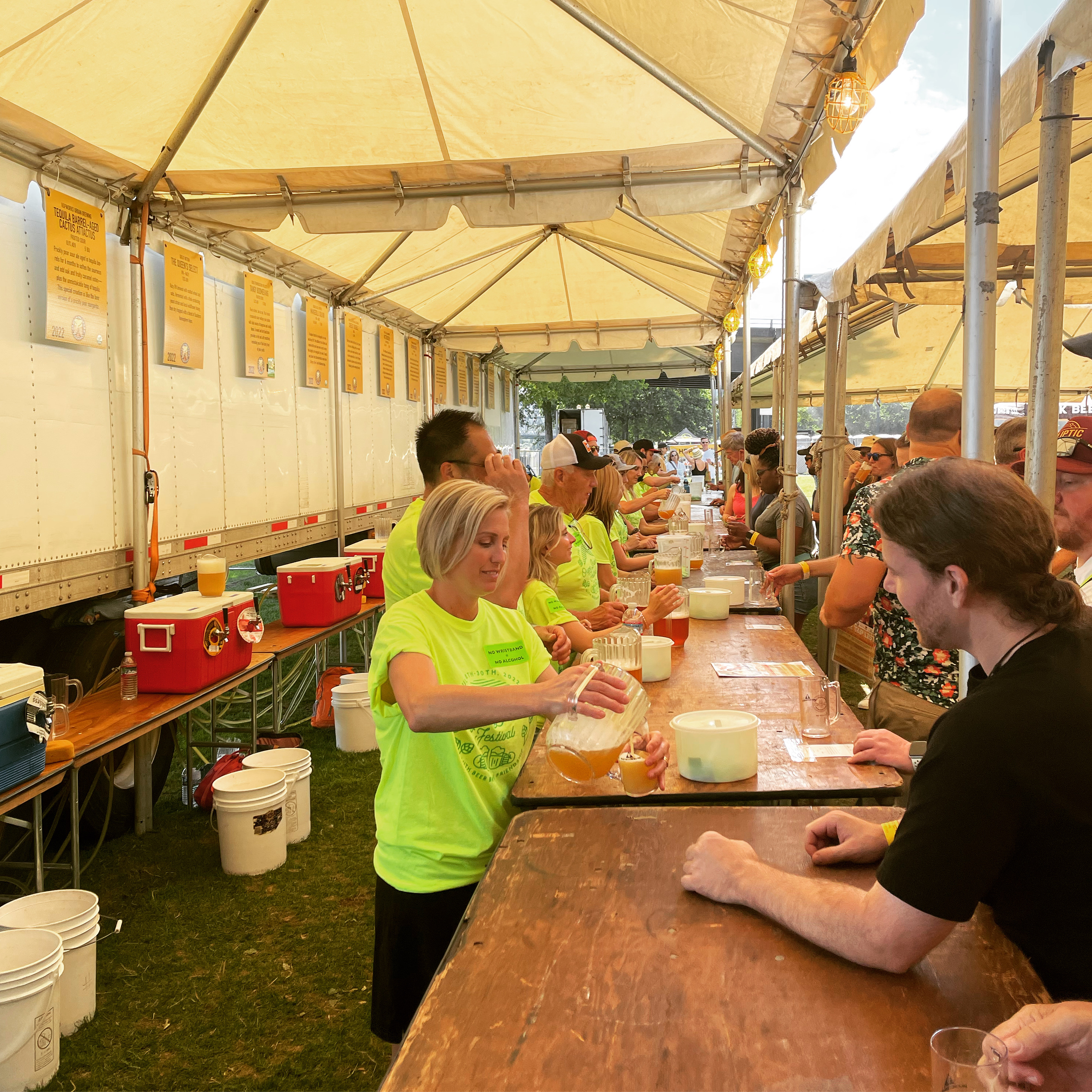

Declining attendance in recent years has helped reinforce the notion that the event is, in fact, irrelevant. But OBF remains the largest beer festival in Oregon, one of the largest in the country. Even with declining attendance, an event like that isn't really irrelevant...until numbers drop to the point where the event is simply canceled. 

I was interested to see what changes organizers would make this year, particularly given the two year pandemic hiatus. They implemented some fairly dramatic changes to address drooping attendance in 2019. This year turned out to be more of the same, although the changes weren't all positive in my mind.

Reduced Days
They cut the festival down to three days this year...Thursday, Friday and Saturday. Many will recall that the fest was four days in 2018 and 2019, after being five for several years. Abandoning Sunday again, as they had done in 2019, was a good call; Sunday had notoriously dreadful attendance for years before it was finally dropped. Wednesday was dropped this year to get the event down to three days, I assume due to attendance woes. No complaints.

The Venue
One of the big changes in 2019 was switching the southside beer taps to the river side of the park, thus opening up the shaded area on the westside of the park for seating. In past years, trailers were situated in the shaded area. 

The 2019 setup was repeated this year. In fact, organizers liked the arrangement so much they eliminated the northside beer taps altogether and moved the entire beer portion of the event to the southside. Yup. The festival grounds were cut roughly in half this year. 

I suppose it was inevitable that the footprint of the festival grounds would be squeezed, given the issues with attendance. But it felt a little odd walking into what had been the central compound and seeing open space where tents and trailers had always been on the northside. 

I wondered how the vendors in that central area were doing. There was definitely less foot traffic there, with the vast majority of people augured in on the southside under the tents or in the shade. Perhaps those vendors paid less for the privilege of being there this year. One can only hope.

Moving the entire beer portion of the event to the southside had it's pluses and minuses. The tents in front of the trailers were larger this year, providing more shade. But the extreme heat and number of bodies under those tents made it rather uncomfortable there. You really needed to vacate the tents once you had a beer, though many did not. The lines weren't bad Thursday afternoon. I'm glad I wasn't around to see what it was like in the evening hours.

When I was looking for a beer at one point, I was surprised to find I couldn't see the beer names until I was close to the taps. As a result, people were often confused about which line to be in. At first I thought the larger tents were responsible, but that wasn't it. In 2019, they had large signs immediately behind each pouring station identifying the beer being poured. Those signs were visible and readable from a good distance. But this year's signs were cheap and small, and they were hung so high that you couldn't see the beer name until you got close. That was not ideal. It's hard to imagine why no one caught it when they were setting up. 

Another change this year was no music of any kind. For most its history, OBF had a stage with bands/solo artists playing live music. You could chill with a beer and listen if you pleased. In 2019, they switched to a DJ setup that pumped music around the grounds. That was an annoying change, as the music was often muddled or too loud. Anyway, problem solved this year: No music or stage. 

Finally, I was surprised to find several rows of standup tables in the common area just north of the beer tents. With the heat and direct sunlight, these tables were uninhabitable during afternoon hours. I stood at one to jot down some notes at one point and didn't return. Tables with umbrellas would have been better, given the heatwave everyone knew would be part of the festival.

The Beers
They were pouring 42 beers and two ciders according to the event program. I saw a bit of bitching and moaning about the beer selection on social media. I looked at the list in advance and didn't think much of it. But I found some pretty good beers in the 15-20 I tasted, along with the usual losers. The list leaned toward light and hoppy, which surely disappointed folks looking for more options.

After holding the line on cost for many years, they moved to a $2 taster (most beers) this year. No one should have been surprised, as prices on everything have skyrocketed since the pandemic. OBF taster size has varied over the years. In 2019, the taster line was 3 ounces. This year, it was 4. The larger tasting size probably allowed some patrons to feel less aggravated by the price increase. Fifty cents for an ounce of beer is a premium price, but it would have been worse if they'd stayed at a 3 ounce taste.

You could get a full glass of beer or cider if you were so inclined. That would set you back three tickets or $6. The glass, billed at 12 ounces and exactly the same size and form factor as 2019, overflows at less than 12 ounces. So a full glass of beer or cider with any head at all is going to be 10-11 ounces. Do the math if you wonder how much worse of a deal that is than a 4 ounce taster. 

As was the case in 2019, there was a printed program this year. They had a mobile app in 2018, but reviews were mixed. I was one of those who actually liked the mobile app and was disappointed to see it go away. But the fact that the 2022 beer list was roughly half of what it was in recent years meant the printed program worked fine. I suspect it's here to stay, unless something dramatic happens.


The Glass and Token Switch
It's become pretty common for beer fests to charge exorbitant prices for "customized" tasting vessels. These plastic glasses aren't special or fancy. OBF has been charging $10 for the tasting glass in recent years. Unless someone shows me an invoice proving otherwise, I assume these glasses cost much less than a dollar apiece. So the glass is nearly pure profit for this and every event that follows the blueprint. The fact that OBF isn't alone in this fleecing doesn't make it okay. 

After using wooden tokens for virtually the entire history of the event, organizers switched to paper tickets this year. They were $2 each to align with taster cost. Most beer centric events have gone to some kind of paper ticket. They're undoubtedly cheaper and easier to manage than wooden tokens. I always liked the charm of tokens, which I found easy to keep track of in a pocket. Oh, well.

The transition from tokens to paper tickets presented an opportunity for organizers to make what I consider to be a dumb unforced error. OBF had always honored tokens acquired at past events. You could simply use old tokens as if they were newly purchased. It was a nice policy. But not this year. With the switch to tickets, past tokens had to be exchanged for paper tickets.

Organizers initially said they would trade tokens for tickets, one to one. That would have been a nice gesture to fans who held onto tokens, getting a $2 ticket for each $1 token. But organizers reneged, saying the initial communication was a mistake. Having botched that communication, doubled the price of a taster and downsized the event across the board, organizers might have been wise to suck up whatever loss they would have incurred in exchange for a little goodwill. No deal.


One thing to keep in mind with respect to tickets: I'm guessing the ones from 2022 won't be honored at any future event, as was the case with tokens. There's a financial benefit to not honoring tickets from past events and it mirrors the reason retailers like gift certificates, knowing full well some or many will never be redeemed: Pure profit! That probably isn't the only reason tokens are being dumped, but it's almost certainly one of them.

Thoughts
OBF 22 felt to me like a dumbed down experience at a higher price. For many years I considered the event to be a decent bargain in terms of time and money. But they've altered its character to the extent that, in its current form, it doesn't represent the value it once did. At least in my mind.

I suppose this year's event could be an aberration. The pandemic created a lot of challenges for beer fests and similar events. Plus, OBF organizers have been struggling for several years to come up with ways to reverse sliding attendance. Maybe this year was a perfect storm.  

My guess, though, is this was a glimpse into the future. OBF once appealed to a wide swath of people. Attendance was growing rapidly for so many years that the event expanded to five days. Some of us thought it would eventually consume an entire week. Instead, the event is imploding, forced to downsize while boosting prices. That isn't a winning strategy.

Honestly, OBF may be approaching obsolescence. The vision at the outset was to provide a platform for craft brewers to showcase their wares. People didn't know much about craft beer in those days and OBF helped change that. That brought the industry into the mainstream. Today, you can find great beer at an endless number of bars, restaurants, taprooms and breweries. 

You might say OBF is victim of a success story it helped author. With great craft beer available everywhere, people don't get as excited about an oversized, awkward event. And the downsizing and price boosting that occurred this year probably aren't a good omen for the future.  

Friday, April 8, 2022

Precious Things Offers Stunning, Welcoming Experience

Reliving the quaint past of craft beer can be interesting...and instructive. Cash laden investors and hedge funds hadn’t yet entered the scene. Early craft brewers were stuck cobbling together makeshift breweries with their personal savings and borrowed money. Craft beer hadn’t yet arrived. 

On a recent trip to Spokane, I entered a worm hole that took me back to yesteryear. The area is home to a robust craft beer movement that’s probably a decade or so behind Portland in its evolution. There are a lot of small breweries catering to a growing audience of fans. 

My travels took me to Precious Things Fermentation Project, located in rural Spokane on the property of Jeff and Candace Clark. There, the Clarks have fashioned a unique experience with a collection of nice beers and a small taproom that has a ton of charm. You can't make this stuff up.

“We’ve been fans of craft beer for as long as we’ve been of drinking age…maybe longer,” Jeff said. “We’ve always been attracted to the camaraderie. It’s impossible to count the number of long lasting and close friendships we’ve made because of craft beer.”

The Clarks got totally hooked on craft beer while they were living in Portland, 2010-2015. Those years were instrumental in what they’re doing now, they say. It was then that they learned how to brew and started collecting the memorabilia that is now featured in their taproom. 

“The vision for what became Precious Things occurred to us about five years ago,” Jeff said. We had a bar set up in our garage, first in Oregon and then in Spokane. People would stop by and drink our homebrew and commercial beers. We had a tip jar, but it always seemed to wind up empty.”

While they enjoyed the experience of having people over and drinking good beer, the cost became unmanageable. They eventually decided to go into business for real and actually become part of the industry they had come to respect and love. 

“It’s ironic,” Candace said. “Many of the people who used to come to our place and drink for free now come here and pay to drink. And they leave tips. They could've saved money by just putting a little dough in the tip jar in the first place.”

Precious Things has a nice list of beers, but it operates on a tiny system. Even by the standards of the early craft brewers, it’s amazing that they get by with what they’re using. Of course, there are reasons for everything.

“Our system is incredibly small,” Jeff said. “You might say it's stupidly small. We still brew on two Grainfather systems we purchased years ago and brewed on before we moved here. Our plan when we moved here was to build a 2-barrel system. But the property won’t allow it.”

The issue with the property is it has a septic system and drain field. There’s no sewer in the area. Water disposal isn’t a huge problem, but disposal of solid waste (yeast and trub) is. The tiny system they have now doesn’t present much of a problem. Anything larger is a problem.

“We continue to use our Grainfathers, and we invested in four small conical fermenters and a glycol chiller to control their temperatures,” said Jeff. “We’ve managed to be open on Saturdays for two years doing this. For the last year, we've had an arrangement with Bellwether Brewing allowing us to brew on their pilot system and enjoy access to dry and cold storage.”

They do plan to expand the brewing system, though the taproom will stay exactly as it is. 

“We’re hoping to build a 3.5-barrel brewhouse here,” Jeff said. “The new building would allow us to move out of Bellwether and brew everything here. We’d also have more cold storage, as well as room to expand our barrel program." 

That plan hasn’t come to fruition because they haven’t been able to find a builder willing to do the work. Home construction in the Spokane area is off the hook crazy.

I had not searched out images of the taproom prior to my visit. It’s housed in what was once a garage. I expected a grubby space and was stunned by the aesthetics when I walked in. The place was packed and the visuals transported me to another place. While I enjoyed a few beers, Jeff and Candace poured beer and mingled with patrons. A most welcoming place.

“The aesthetic of our taproom has been influenced by places we love in Portland and beyond,” Candace said. “Places like Horse Brass Pub, Saraveza and Belmont Station, as well as the Cat's Eye Pub in Baltimore and the Delirium CafĂ© in Brussels. We really love to drink beer at places that have a lot of things to look at.”

For the Clarks, the overriding mission has always been to create a community of craft beer drinkers. That mission appears to have been largely accomplished in the two years they’ve been open. The busy taproom was evidence enough of that. 

“We love learning about beer, talking about beer, brewing beer, and of course drinking beer,” Jeff said. “We make beer for people we like and people we want to meet. If you love any of those things (learning, talking, brewing, drinking), then we make beer for you!”

If you find yourself in the Spokane area, a trip to Precious Things is definitely recommended. They don't currently have a website, but you can find them on Facebook and Instagram.


Friday, December 7, 2018

The Uncertain Fate of the Craft Brew Alliance

I last discussed the Craft Brew Alliance roughly a year ago, just after they shut down the Gasthaus pub and turned it into a taproom for their small batch beers. That move was designed, at least partially, to make the CBA a juicier buyout target for Anheuser-Busch. But nothing has happened. What gives?

To understand why many assumed a buyout was imminent, you have to go back to the contract AB and the CBA signed in August 2016. That was a different time in craft beer, predating the market saturation and instability we see now. The document, which was a renewal and expansion of a prior contract, heavily favored the CBA and effectively established a framework for a slow moving buyout.

Giveaways in the contract involved domestic distribution costs, contract brewing opportunities, international distribution rights and more. They are covered thoroughly in the piece I wrote back in 2016. Rather than repeat those details, you can find them here if you're so inclined.

The reason many assumed a buyout was coming is the contract set escalating "qualifying offer" prices. By August 2017, a qualifying offer to buy the CBA had to be at least $22 per share. By August 2018, the number rose to $23.25 per share. By August 2019, a qualifying offer is set at $24.50 per share. There was incentive for AB to act sooner than later.

The allure of easy money attracted speculators. Soon after the new contract was announced in 2016, the CBA's stock price, which had been hovering around $14 per share, jumped to above $20. It hasn't yet worked out for the speculators that jumped aboard. The stock price has bounced around a bit, but shown life in July and August in each of the last two years, as speculators positioned themselves to cash in. It closed at $15.80 on Friday.

Given the structure of the contract, it's fair to wonder why the expected buyout hasn't happened. We all understand it's a different craft beer climate these days. Some of the big shots at AB have said they're comfortable with the High End portfolio as it is. They say they're focused on paying down debt acquired in the SABMiller merger/acquisition. Right.

The reality, though, is that Anheuser-Busch could not have gone through with a buyout in the wake of the SABMiller deal. It had to wait for the Department of Justice to complete its review. The "consent decree" was only recently issued, which means it's open season again, subject to certain limitations. One condition is that AB must give 30 days notice of any acquisition.

Opinions on whether a deal will happen on the 2019 timeline are mixed. Some believe the market is too unstable and that AB will stay focused on the craft assets it has and delay future acquisitions until the dust settles. That's not necessarily a bad argument.

However, there are sound reasons to believe a buyout may happen. Foremost is Kona, which continues strong growth despite the funk descending on the industry as a whole. Kona drove 64 percent of the CBA's total shipments during the first nine months of 2018 and its international potential is virtually untapped.

On the flip side, the CBA's legacy brands, Widmer and Redhook, are in decline and have no value to AB. They wouldn't be a stumbling block given the appeal of Kona, but they would likely be spun off in a buyout. It's ironic, for sure, given the history, but that's the way it is.

Should Anheuser-Busch fail to make a qualifying offer by August 2019, the contract stipulates that it pay the CBA a $20 million "international volume development incentive" fee. Those fees were $3 million in 2016 and $5 million in 2017. The $20 million balloon payment was put in the contract to leverage the imperative of a buyout.

It's entirely possible that AB moves forward in coming months. Since it already owns 31.4 percent of the CBA, it would spend only about $330 million (at $24.50 per share) to gain full ownership. That isn't a huge financial hit in a company so focused on reducing debt that it recently cut dividends to the tune of $4 billion a year. The spin for shareholders would be that the acquisition saves and makes the company money.

The fly in the ointment is the state of the industry. There are a lot of nervous folks out there. Some fear we are looking at a repeat of what happened in the late 1990s, which in our present context would mean dozens, if not hundreds, of brewery closures, and a depressed market for several years, at least. It's a serious and realistic concern.

On the other hand, there's Kona, seemingly impervious to market conditions. Even in a shrinking beer market and with overall craft sales flat or barely growing, Kona continues to surge. It's been dragging the CBA forward for several years and has the kind of brand appeal that a lot of companies covet. Kona may be one of the few gems left and AB already owns a piece. Why not own it all?

With all that in mind, I rate the chances of a buyout before the end of August 2019 at less than 50 percent. The incentives for AB to own Kona outright are significant. One thing that would certainly scuttle a deal is a sudden slowdown in Kona's growth trajectory, a scenario that would also cripple the CBA.

Anheuser-Busch may very well let the buyout timeline expire in 2019. When the contract was renewed in 2016, the parties didn't anticipate the slowdown we're seeing. They foresaw continued rapid growth in the craft segment. The qualifying offer minimums were set to protect both parties, but it turns out the numbers were set too high and are now an obstacle.

Should the August 2019 deadline pass without a deal, the CBA will receive the $20 million international development payment. It will also continue to benefit from all other aspects of the contract, including distribution, contract brewing, etc. The CBA would, of course, be open to offers from other suitors, though it's difficult to imagine who might be in the market.

The CBA's stock price will likely level off at around $14-$16 in that scenario, only slightly higher than it was before the contract renewal and buyout provisions artificially boosted it. If Kona falters, the stock price could take a significant hit, possibly into single digits.

It seems entirely plausible that AB plays a waiting game that extends beyond the 2019 deadline. Unless they want to be really generous with their CBA friends, they'll watch what happens with Kona and the overall market. If Kona continues to look strong, they'll likely proceed with a buyout for something less than the current $24.50/share price.

Crapshoot on.


Monday, January 25, 2016

Expect Millennials to Continue Drinking Heavily

Looking through the flood of beer-related emails in my inbox, I was amused to see a story announcing the possible end of craft beer. Hey, I realize click bait is a fact of life these days, and I make a conscious effort to steer away from those links. But this was too good to ignore.

The crux of the story is that the millennial generation is moderating its consumption of beer and other alcoholic drinks. This news comes via a poll of 5,000 drinkers, age 21-35, in the UK, US, Mexico, Brazil and the Netherlands. 75 percent of these folks say they moderate their alcohol consumption most of the time because it improves their quality of life.

Heineken has actually launched a "Moderate Drinkers Wanted" campaign designed to tap the supposedly shifting millennial values. You may have seen the ads, which have been airing during sporting events and similar programming. Heineken apparently thinks the good citizen motif is worth something.

The whole thing comes as a huge surprise to me. Most of my experience mingling with these folks at festivals, bars and such is that they exert little self control when it comes to drinking. Maybe the poll sample wasn't large enough to be representative. Or maybe Oregon millennials weren't polled.

Of course, if millennials really are throttling back on alcohol consumption, it's bad news for craft beer. Because these folks are probably the biggest driver of the crazy, off-the-hook growth we've seen over the course of the last few years. The industry desperately needs them!

The reason these folks have pushed growth is they are aggressively promiscuous drinkers, constantly searching for new flavors, innovative styles and bizarre interpretations of almost anything drinkable. You might say they'll try anything once. Or twice.

It's really hard to imagine a scenario in which millennials seriously cut back on their drinking. These folks may be fickle and probably are more prone to shifts in attitude and habit than prior generations. But there are a lot of things driving their drinking.

Such as the fact that many American millennials have been saddled with tremendous education debt. Many don't and won't own a house or car. Due to unfunded liabilities in public and private retirement funds, millennials will be asked to finance the retirement of the baby boom generation while working shitty jobs in a downsized economy. And don't forget the trampled environment and corrupt political system they're inheriting.

These kids have got a tough road ahead and it's going to drive them to drink. The only real danger to craft beer is that millennials will shift to hard liquor. They're going to need it.

Monday, June 15, 2015

Don Younger and the Breakdown of Local Beer

Most who stop by here know the craft beer industry as it exists today was largely built on the connection between local communities and good beer. As Don Younger famously quipped when talking about why we love Oregon beer, "It's not just because the beer is good; it's because it's ours."

In fact, interest in local beer is apparently growing, particularly among the Millennial demographic. Nielsen stats included in an article written by a friend of mine, Jason Notte, suggest Millennials (21-34) are more likely (53 to 45 percent) to prefer local beer than the demographic that includes all legal aged drinkers (read that older drinkers).

Don't read too much into those numbers. They're about what we should expect. Because folks over 40 are typically less engaged in the sort of fad-driven scenes that kids live for. Craft beer is part of that and something older folks don't care as much about. So these numbers aren't really so surprising.

Still, the Millennial interest in local beer is great for the 3,400 operating breweries who have a dedicated clientele. According to Notte's article, 75 percent of drinking aged Americans now live within 10 miles of a brewery. With 2,000 additional breweries on the way, you have to wonder when the number will be 5 miles. Or less. That's pretty wild considering where we were 30 years ago.

The most perplexing aspect of this story is the fact that growth is effectively undermining the local premise upon which the industry was built. Here's how:

First, there's the growing number of small breweries and brewpubs. The more of these we have, the more they compete for the same customers, which means they eventually look outside their own areas for business. Keep in mind that these are relatively low profit ventures. If you own a brewpub, your path to fame and fortune is through scale and expanded reach.

Second, there are the large brewers, who are expanding market share by building breweries far from their home markets. Sierra Nevada, New Belgium, and Widmer are among those who have already done this. More soon will. Because they're aware of the local preference, these brewers strive to produce beers that appear to be local wherever they are. Thus morphing the definition of local.

The contradiction is clear: Despite the fact that beer fans apparently prefer locally made beer, industry trends mean craft beer is becoming less local. What this means going forward is unclear.

Getting back to the opening, it's fair to wonder what Don Younger would think about this. As I've said here before, I never met Don. My guess is he'd be ecstatic about the growth craft beer has seen in recent years. And troubled by what's happening to the concept of local production. Just a guess.


Wednesday, May 27, 2015

Revolution in Beer and Food Has Benefits

One of the most significant forces behind the ultimate success of the craft beer movement is the paradigm shift in tastes that began to occur in the early 1960s. The shift in tastes powered an interest in better food and better drink, thus leading in a roundabout way to what we have today.

In my book on Portland Beer, I suggest that Julia Child's Mastering the Art of French Cooking, first published in 1961, is a significant indicator of emerging attitudes. Child's book was probably more a reflection of what was happening than an actual driver of change. But you get the idea.

The underlying reasons for the shift in tastes have been documented in a number of places over the years. A generation of Americans raised on the bland, processed cuisine of the post-WWII era began to search for better options. That quest eventually drove a revolution in food and beer.

The movement was not monolithic or instantaneous. Some parts of the country were slow to catch on or never quite did. Regardless, it took years to see where things were headed. Culinary values that embraced local ingredients and artisan preparation were the first to emerge.

Today's vibrant restaurant scene owes its existence to changes in tastes that were set in motion so long ago. The movement has produced collateral benefits, such as artisan farming and farmers markets. Small scale, community-oriented farmers have benefited in a big way. And they continue to do so.

The link between what happened in food and what would happen in brewing was imported beer. People like Fritz Magtag, Kurt Widmer and others (including the late Don Younger) noticed that folks enjoying a fine meal at home or in a restaurant didn't mind paying a premium price for a good imported beer. They saw opportunity.

As the craft beer revolution was getting underway 35 years ago, one of the problems early brewers faced was that the industry was built around gigantic factory breweries and industrial lagers. Hops and barley production was geared around the needs of large, not small breweries. Mass production was the bottom line. Quality ingredients were not the priority.


In much the same way that the culinary movement helped revive local farms and food production, craft brewing has transformed the hops and barley industry. The proliferation of craft breweries has opened up opportunities for growers who produce specialty hops and grains needed to brew the complex beers of today. This is happening in a lot of places, not just Oregon.

What's good about this? Similar to the culinary movement, craft beer has enabled smaller producers in small communities to shine. You don't have to be a mega grower to meet the needs of craft brewers. What you need to do is produce a high quality product. Even the large growers have had to take note and adjust their thinking and approaches.

Honestly, there are plenty of things about craft beer that aren't quite right. Pretentiousness, sexism and greed, for starters. But the industry has traversed a path that has helped revive small producers and, in turn, small communities. You can't argue with that.

Tuesday, January 20, 2015

Hollywood Hot Lips Leans on Craft Beer

The evolving facade of Portland's craft beer scene got another face lift with the opening of Hot Lips Pizza in the Hollywood district. It's the sixth Hot Lips location and, for the record, they are getting more than a little serious about good beer. More about that shortly.

The Hollywood location opened just over a week ago in the space previously occupied (since 1937) by Pal's Shanty. Most locals know an arson fire gutted Pal's in late 2013. Although they had hoped to reopen, plans fell through and the space became available to Hot Lips.

For the unknowing, Hot Lips is a family-owned business that has been making and selling gourmet pizza since 1984. For most of that history, they have focused on molding a sustainable business model, with an emphasis on locally-sourced ingredients and production.

Many are familiar with Hot Lips sodas, which are sold at Hot Lips and at many grocery stores in the area. These beverages are made using locally grown fruit and they are terrific. One of the very real challenges for Hot Lips is making enough to meet the demand. That's how popular the stuff is.

Part of the reason the sodas were developed is that co-owner David Yudkin wanted to offer something more than just pizza. The sodas, made as they are from local fruits and related ingredients, were a nice fit for the sustainable model. Plus, they provide something tasty that appeals to patrons, always an important factor.

Similar logic is in play with the expanded beer selection at the Hollywood location. Hot Lips stores have always offered beer in recent times. But the new Hollywood store blown the standard approach up with 22 taps, almost all of which will pour craft beer. That's a significant sea change.


"What we've done in Hollywood is part of an evolution," Yudkin told me. "There's a huge and growing demand craft beer here and it makes good sense for us to cater to that demand. Beer and pizza are a legendary pairing, like peanut butter and jelly or sausage and mustard. Hollywood gave is the opportunity to build a wall of taps right into the restaurant. We went for it."

Of the 22 taps, only six or seven were pouring beer when I visited on their first day. It was a decent selection, but I suspect they have a full complement of beers by now. The lines run a CO2/nitro blend with regulators for each set of four taps (two of the 22 are strictly nitro). In addition to the draft stuff, they carry a selection of bottles and cans. Growler fills are available.


If the beer choices follow the overall Hot Lips theme, expect to see mostly Oregon beers on tap and in bottles here. Yudkin mentioned the possibility of bringing in some beers from outside the area, and maybe he will. But his intense focus on carbon footprints and sustainability almost surely mean the beer focus will be mostly local.

Keep in mind that Hot Lips operates a delivery service via its fleet of fuel efficient cars and that they will deliver beer with your pizza. That's a user-friendly arrangement. As well, the Hollywood beer model may well be applied elsewhere in Hot Lips family.


"Considering our goal of supporting our fellow local businesses, I think offering a broader variety of local craft beers at all of our locations is a logical next step," Yudkin said.

That makes perfect sense to me. Bring it on.

Saturday, November 29, 2014

Holiday Ale Fest Returns for 19th Year

They say Pioneer Courthouse Square is Portland's living room. Assuming that's the case, Portland's living room will welcome back the Holiday Ale Festival next Wednesday through Sunday. This is the event's 19th year, if you're counting.

There aren't really a lot of secrets with respect to this festival. It routinely features bold beers. These aren't run of the mill beers.The great bulk of what you'll find pouring here is made specifically for the event. They have a way of getting some great stuff. We're talking high octane ales, barleywines, barrel-aged beers, etc. Perfect for winter.

As most know, the HAF is housed under clear, heated tents. The weather may turn out to be perfectly dreadful outside, but it will be warm and toasty under the tents. So you won't need to wear your favorite ski outfit to be comfortable. Views of the city skyline and the holiday tree add to the festive appeal of this event.

Another interesting thing about the HAF is it seems to attract people from all over the place. I've mentioned this in previous posts, but it's worth mentioning again. I can't count how many times I have met people who are from faraway places. They come for this event and for all that is Portland.

Because things tend to get a little nuts during prime time, organizers again say the best days to taste are Wednesday, Thursday and Sunday. The first two days are good because a lot of working stiffs can't get down there until the evening, if at all. Folks who show up on Friday or Saturday will likely have to deal with some lines, although it usually doesn't get too wild until mid-afternoon.


There are plenty of details available on the event website here. For example, you can pre-purchase a tasting package there. The beer list is there. A couple of significant factoids to keep in mind: This is a 21 and over event and the kiddies are not welcome.

As for recommended beers, I'm quite sure everyone can manufacturer their own hit list from the online program. If you want to know what the experts are tasting, there are plenty of online and print sources you can consult. As for myself, these are a few of the brews I hope to try:

13 Virtues Brewing Co.
Barrel-Aged MAX Stout
Imperial Stout
10.5% ABV, 70 IBU
Aged in both Eastside Distillery and Bull Run Distillery Whiskey barrels for three to four months, supposedly offers the complexity of oak and vanilla notes and textured layers of deep, dark secrets. I'm sold.

Firestone Walker Brewing
Luponic Distortion 
Double IPA
8.5% ABV, 75 IBU
A complex blended IPA boasting huge citrus notes by the crafty use of Cascade, Centennial, Citra, Amarillo, Chinook and Simcoe hops. Sounds worthy.

Fort George Brewery
Santa's Dinner Jacket 
Bourbon Barrel Aged Imperial Red Ale
8.3% ABV
Aged in Bull Run Distillery barrels. Sipped slowly and allowed to warm, this beer tells a story of time spent in the barrel infusing this heftily hopped ale with notes of port, sherry, caramel and toffee. 

Gigantic Brewing 
Red Ryder BB Gun
Cranberry Saison
6.3% ABV, 22 IBU   
The sweet aroma of cranberries melds perfectly with spicy saison yeasts. There is just enough fruit and tartness to balance the beer's finest pilsner malt. Sounds like a live one.

Hopworks Urban Brewery
The Incredible Abominable of the Enchanted Barrel Forest 
Barrel Aged Imperial Winter Ale 
9.0% ABV, 100 IBU
The infamous uncle of the renowned Abominable Winter Ale.This imperial version was aged in freshly emptied Woodford Reserve Bourbon barrels and features notes of vanilla and spice mixed with the already delightful flavors of citrus and caramel.

McMenamins Edgefield Brewery 
Lord of Misrule   
Rum Barrel Aged Imperial Mexican Mocha Stout 
7.6% ABV,. 24 IBU
This dark and spicy imperial brew was made keeping all the joyful customs surrounding this ancient practice in mind. Brewed with cacao nibs, kilned coffee malt and habanero peppers, then aged in rum barrels post-fermentation. 


Migration Brewing 
Frankie Claus
Belgian Imperial Stout
11.8% ABV, 60 IBU  
This Imperial Belgian Chocolate Stout was brewed with French cocoa, Belgian Trappist yeast, and plenty of attitude. Frankie Claus is layered with notes of banana, cocoa, dried red fruit and toasted almonds, creating a very smooth 11.8% ABV stout with a soft, warming finish.

Portland Brewing
Bourbon Barrel-aged Imperial Stout 
Bourbon Barrel Aged Cherry Stout
10.0% ABV, 25 IBU
Brewed just for the 2014 Holiday Ale Festival, this massive brew boasts a huge backbone from seven different malts, a Northwest hop profile, and notes of roasted coffee balanced by delicious cherry flavors from an Oregon-grown sweet cherry puree.


Stone Brewing 
New Desecrator
Black Barley Wine
12.0% ABV, 100 IBU
This black barley wine has nearly the same profile as Stone Old Guardian, but surrounded by de-husked darkness. To give this demon its own flair, Stone fed it generous portions of Herkules, Amarillo, Comet, El Dorado and Pacifica hops. Coming in at 100+ IBUs, Stone says New Desecrator may just kill Santa Claus and end your holidays early. Yikes!

Of course, there will be a number of special beers tapped during the course of this event. If you want to follow that stuff, there's a mobile version of the Holiday Ale Festival website that your smartphone will automatically detect. Tune in there for on-the-fly updates on special tappings and locations, as well as other event details.

Wednesday, November 5, 2014

Millennials and Craft Beer in the Digital Age

It's hardly a secret that Millennials are a force to be reckoned with in modern American business. They make up an increasingly significant portion of the 25-45 age group business covets and targets. This is as true of the beer industry as any other.

The problem for business is the Millennial demographic is not receptive to traditional marketing strategies and tactics. You cannot effectively reach them via print, radio or television advertising. One might argue that's because they are fixated on computer, tablet and phone screens. But never mind.

There are a lot of things businesses have to keep in mind with Millennials and plenty of places to find that intel if that's your thing. Generally speaking, these kids identify more personally and emotionally with brands than prior generations. They demand to interact and be part of the brands they respect.

The platform that makes this stuff happen is provided by the combined emergence of the smart phone and social media, which allow good and bad experiences to be widely spread electronically in the blink of an eye. This kind of instant publicity was unheard of 10 years ago. Today it drives the success of many businesses...and Millennials are heavily immersed in it.

When it comes to beer, Millennial tastes are vague and transient. They want to experience a wide range of flavors, which means they are receptive to inventive approaches and bizarre blends, and somewhat bored by traditional styles. In short, they are regularly looking for something new and different.

That reality is forcing suppliers and retailers to radically increase the number of available choices. A reliable industry source expects the number of SKUs on the market to double within 10 years. That's a significant increase given there are already something like 10,000 SKUs out there.


These changes mean chaos for big beer, whose leadership is dominated mostly by folks who have been around for 20 or more years. Age alone isn't the issue. The more serious problem is they are stuck in an antiquated mindset. Expensive ad campaigns and traditional media are yesterday's news...they fall flat with Millennials.

Craft beer is another story. Small breweries and pubs never had the luxury of using expensive, traditional media. Building a brand identity took years. Then came social media and the smart phone. Today, craft-centric businesses are leveraging the digital space and effectively engaging with the all-important Millennial demographic. Craft brands are being built quickly, almost overnight in some cases.

In other words, the brand building shoe is now on the other foot. Being small and unable to afford expensive advertising tactics has put the little guys ahead of the big guys in the digital, Millennial age. If nothing else, you have to appreciate the irony.

Sunday, March 10, 2013

Whole Foods Tigard has a Better Beer Idea

Once upon a time, back when companies spent money on real marketing, Ford launched its Ford has a Better Idea campaign. This was back in the days when the media was highly centralized and Ford got a lot of mileage out of this campaign. You saw it in print, watched it on TV and heard it on the radio. It was a big deal.


It was never exactly clear to me if Ford actually had a better idea. I'm quite sure there were arguments on both sides of that question. Nonetheless, in the world of business, which includes beer, some ideas are clearly better. No, I'm not talking about light beer.

Sometimes you run across great ideas in unexpected places...in this case at the Whole Foods Market in (Bridgeport Village) Tigard. I stopped there last week as part of the wacky contract work I do. No, that work doesn't involve beer. Inside the store, I discovered something I'd been hoping to find in a grocery store for quite a while: beer taps and growlers.

Lookee here...beer
The taps are located toward the back center of the store in what is essentially a makeshift pub called Butcher's Brothers. They serve barbecue goodies and related foods, and there are six taps pouring five beers and a cider. While I was stalking the joint, I observed several sets of people enjoying food and beer. Who says a pub in a store can't work?

About the tap list. They were pouring Boneyard Hop Venom, Deschutes Red Chair, Bridgeport Smooth Rye Ale, Mac & Jacks Amber and Rogue Roguenbier Rye Ale. The cider tap was occupied by Angry Orchard of Ohio. They tell me two of the beer taps, as well as the cider tap, will rotate. They were running a $10 special on growler fills (with free glass) to help get the word out. Fills will cost more than that going forward, but prices will be competitive.

The pub inside the store
The man who helped make this beer bonanza happen is Dan Phillips, the store's beer specialist. I spent some time talking beer with him and he knows all the nooks and crannies of the business. Dan is a Florida transplant. He moved to Oregon several years ago and spent some time in the wine business. But beer was his passion and he eventually wound up at Whole Foods. Managing the beer department. I'll let him take over:
Honestly the Whole Foods gig was a chance to show that they needed a friendly foodie like me to help bring their beer set to life. It's a chance to show them what a business savvy enthusiast could do with it. I think the most shocking thing I ever heard from one of my team leaders was that they couldn't believe beer could have so much success. I was like, "Excuse me. You do know you're in Portland, right?" I have passion for it and I give it 110 percent. I love the culture, the people and, of course, the beer. Each one makes me strive harder to learn more and meet the people who have made it successful. As an east coast enthusiast who dreamed of enjoying a west coast life of beer, I have to say I'm one step closer.
Let me take a step back for just as second. This particular Whole Foods is gigantic compared to the smaller ones we have in the city. I don't want to guess the square footage. The manager on duty told me the Tigard store does a huge volume. Sure enough, it was packed with suburbanites on a late Sunday afternoon.

A closer view of a good idea
I suspect this is the perfect place to try the beer and growlers experiment. Folks out in suburbia don't enjoy the same beer culture we do in the city. I'm not saying Tigard is all that much of a hoof, but there are four breweries and numerous pubs within walking distance of my house. My options are almost unlimited. It's different out in the burbs.

Dan told me he spends a fair amount of time talking to customers. Some might call that education and I think that's a mistake. What he's really doing is sharing his thoughts, ideas and knowledge with people who want to know more about craft beer. Talk about a perfect fit. I'm probably not your normal customer (I have a lot of stubborn opinions), but we talked for nearly an hour.

A customer evaluates the beer wall
This is evidently the first Whole Foods store in Oregon to play around with on-premise beer sales and growlers. They plan to see how it goes. Of course, having draft beer and food opens up some interesting opportunities. Dan said they expect to offer dinners with beer pairings, and will likely invite brewers to come in and talk about their beers. What a terrific idea! If all goes well, more taps may be added down the road.

In case you're wondering, draft beer isn't the only thing they've got going at the Tigard Whole Foods. Dan has put together a very impressive beer wall. One of the cool things about Whole Foods (regardless of how you view the owner's politics) is the beer specialist/buyer essentially owns the beer section. This runs counter to the way it works at most big box stores, where a suit somewhere tells you what to carry and how to arrange the shelves.

Parting shot
Dan told me everything on his shelves is a decision. That doesn't mean he's going to ban a beer he personally doesn't care for. That would be bad business if the beer is something customers want.  Coors Light, for example. His strategy has been to gradually build a selection of fine beers as the clientele gets more sophisticated about what they're looking for.

The approach to beer at this particular store is quite fresh. I can't say I necessarily expected to find such vision here, but there it is. Everyone involved in putting this plan together deserves a lot of credit. They clearly have a better idea when it comes to beer.

Update: I'm hearing that other stores in this area are doing something like what they're doing at this Whole Foods. This is simply the first instance I've seen.

Thursday, September 15, 2011

Fifteenth Ave Hophouse Looking Good

Spacious outdoor seating adds to the experience
We've seen a lot of new breweries and pubs opening their doors in recent times. I particularly enjoy seeing the new pubs and tap houses that bring in quality beers from around the region and beyond. These places don't brew so their only loyalty is to great beer.


The Fifteenth Avenue Hophouse (cross street is NE Brazee) opened a few weeks ago and is just now gaining momentum. This place is connected to the Hawthorne Hophouse (41st and SE Hawthorne). I visited the Hawthorne location over the summer and was impressed by the beer selection and vibe.

The Fifteenth Avenue location is follows the same line of thought. They have more taps here, 33 in all. Most of these taps pour beer, but a few pour cider and wine. There are no bottles of any kind here, which swerves away from the recent trend of pubs doubling as bottle shops.

Like its brethren on Hawthorne, Fifteenth Avenue has a pleasant ambiance. There is a spacious, comfy outdoor seating area. The interior is quasi-plush, in keeping with the general theme of the surrounding Irvington neighborhood. They had a gent playing acoustic guitar and singing when I visited, adding to the vibe.

Expect great beers here. They were pouring beers from Ninkasi, Nectar, Oakshire, Boneyard and Natian, among others. I tried Red Nectar from Nectar brewing, on the barkeep's advice. Wow. This is a perfectly matched mix of malt and hop flavor, aroma and bitterness. I wasn't surprised to learn Firestone Walker makes this beer or that it won a Gold Medal at the 2010 Great American Beer Festival in the American Amber category. Great stuff.

They are still in the process of getting their menu completely up-to-speed. Fifteenth Avenue apparently has a larger kitchen than the Hawthorne location and they expect to serve some higher end fare to go with the standard pub menu we all know and love.

They had some issues getting this place open due to opposition in the neighborhood. But it  isn't a strip club and it isn't a tavern, either. The low key ambiance goes perfectly with the surrounding area. I suspect the Fifteenth Avenue Hophouse will do well.