Here we are nearly three months into 2017 and not a single notable US craft brewery has been bought by big beer. That's not the scenario many predicted. After several years of intense activity, many expected to see more buyouts this year. Nope. What the hell?
A good part of what's going on can be traced to the dramatic craft slowdown that occurred in mainstream outlets during 2016 and is continuing into 2017. The other day I talked about why the slowdown isn't as serious as the data suggests. That logic still holds.
Indeed, it's clear that craft growth is happening in smaller outlets that aren't tracked by IRI or Nielsen. Beer bars, breweries, taprooms, growler stations and related outlets have multiplied like rabbits in recent years and are stealing a lot of volume from mainstream stores.
And collapsing sales in mainstream grocery and convenience stores are a serious issue for potential craft suitors. Missed sales projections by large and small brands and an imploding category have deal makers like Anheuser-Busch and MillerCoors on edge. They're afraid to pull the trigger.
Fear of a sagging market isn't the only reason checkbooks aren't opening. The big box slowdown means it's now a buyer's market out there. Deals that were being negotiated or contemplated are dead or being reevaluated. Paying too much for something that tanks is a risky career move.
The uncertainty extends to other buyers. Private equity is in the same boat as AB and MC. They see a soft market that looks increasingly risky. Reports suggest some of the more recent private equity acquisitions haven't panned out very well. Craft is no longer an investment darling.
Another bad hombre is debt. The industry is swimming in it. Anheuser-Busch and MillerCoors both have it, thanks largely to MegaBrew. They'd like to pay it down before they take on any more. Brewers have debt problems, too. Many borrowed to finance expansion when things were booming. Now they're stuck. They can't afford to sell at the prices suitors are offering or might offer. Debt is a double-edged sword in a sketchy market.
Consider the case of Speakeasy Brewing, which just closed. They've been around 20 years. They took on debt to expand. But the growth they expected failed to materialize. They were badly over-leveraged and sought capital to keep going. Lenders wouldn't play ball in this market and they were forced to close. This may be a common theme until things stabilize.
As far as the big boys go, they're moving from acquisition to consolidation, focused on the craft brands they have. The High End is putting a lot of effort into getting its beers in grocery sets around the country. That's going to be the status quo for awhile and it's going to impact small brewer access to shelves in large stores and national chains.
The flip-side of that effort is a place like the recently opened Breakside brewpub in Slabtown. Breakside has built a solid reputation with great beers. It distributes fairly widely. But the Dekum pub is tiny and the Milwaukie facility is for production. Breakside wanted a stronger presence in the local market. So it invested a lot on a marquee location that will achieve just that.
My newest (anonymous) industry friend predicts we're moving toward a system that is both hyper-local and hyper-national. He sees the High End and related MC brands eventually dominating national chains, while smaller breweries, like Breakside, dominate local pubs and such. He may be onto something. We shall see.
As for buyouts, don't expect to see many for awhile. The indicators are too negative. Breweries that took on debt expecting high growth or a big buyout are in deep trouble.
Showing posts with label 2016 sluggish craft beer growth. Show all posts
Saturday, March 11, 2017
Monday, December 19, 2016
Bumps in the Road for Craft in 2016
As previously discussed here on more than one occasion, 2016 has been a tough year for craft beer. On the heels of several consecutive years of double-digit growth, there was a significant decline this year in the all-important retail channel.
Recent stats for grocery (in proprietary publications) show craft up just over 7 percent in dollars and 4 percent in volume for the year. The picture is worse for the 12 weeks through late November, which show dollar growth up less than 4 percent and volume under 2 percent.
There are reasons for everything, of course, and part of why craft is suffering in grocery is surely the brewery explosion. Local beer is more readily available to folks who didn't have easy access to it before. But that's only part of what's going on, I think.
Seasonal beers are another part of the story. Those beers are typically strong in retail and grocery stores between October and December. Not this year. Seasonals are down 8 percent for the year in multi channel retail, and down well over 9 percent in recent weeks.
The reality is that seasonals don't carry all that much weight these days. In our wacky craft beer world, "seasonal" is code for beer that is "old and tired." It's specialty beers consumers are chasing, beers that are rare and unique in some way. Tried and true seasonals are old hat.
Another pesky piece of the puzzle is imports, which have seen increased dollar and volume growth across all retail channels this year. That momentum accelerated throughout the year and reached double-digits in some retail channels over the last 90 days. Right where craft ought to be.
Could price differences be the reason for craft's decline and imports rise? Interesting idea. The average price per case (from a proprietary publication) of imports across a wide retail spectrum is about $30, compared to craft at about $36 per case.
I can't think of many mainstream imports I'd choose to buy instead of well-known crafts from places like Sierra Nevada and Deschutes. Even at a lower price point. I get that imports suggest more flavor and specialness than domestic macros. But most of the imports I see in grocery and convenience stores are seriously lacking.
If consumers really are turning to imports, maybe craft prices have gone too high. It's something I've wondered about since I saw six-pack prices at my local Fred Meyer pass through the $10 and $11 barriers. The notion of a $36 per case craft beer is pretty sketchy for non-sale beer. Seems low.
It's a pretty good bet that rising prices are a drag on craft growth. The gap between dollar and volume growth was fairly wide in recent years. Dollars stayed well ahead of volume because consumers accepted rising prices. But that's changing. The gap has narrowed, suggesting some (perhaps much) of current craft volume growth is fueled by discounting.
We face a lot of unknowns as we close out 2016 and move into the new year. That's as true of the beer industry as it is of the transition in Washington, D.C. Hang on.
Recent stats for grocery (in proprietary publications) show craft up just over 7 percent in dollars and 4 percent in volume for the year. The picture is worse for the 12 weeks through late November, which show dollar growth up less than 4 percent and volume under 2 percent.
There are reasons for everything, of course, and part of why craft is suffering in grocery is surely the brewery explosion. Local beer is more readily available to folks who didn't have easy access to it before. But that's only part of what's going on, I think.
Seasonal beers are another part of the story. Those beers are typically strong in retail and grocery stores between October and December. Not this year. Seasonals are down 8 percent for the year in multi channel retail, and down well over 9 percent in recent weeks.
The reality is that seasonals don't carry all that much weight these days. In our wacky craft beer world, "seasonal" is code for beer that is "old and tired." It's specialty beers consumers are chasing, beers that are rare and unique in some way. Tried and true seasonals are old hat.
Another pesky piece of the puzzle is imports, which have seen increased dollar and volume growth across all retail channels this year. That momentum accelerated throughout the year and reached double-digits in some retail channels over the last 90 days. Right where craft ought to be.
Could price differences be the reason for craft's decline and imports rise? Interesting idea. The average price per case (from a proprietary publication) of imports across a wide retail spectrum is about $30, compared to craft at about $36 per case.
I can't think of many mainstream imports I'd choose to buy instead of well-known crafts from places like Sierra Nevada and Deschutes. Even at a lower price point. I get that imports suggest more flavor and specialness than domestic macros. But most of the imports I see in grocery and convenience stores are seriously lacking.
If consumers really are turning to imports, maybe craft prices have gone too high. It's something I've wondered about since I saw six-pack prices at my local Fred Meyer pass through the $10 and $11 barriers. The notion of a $36 per case craft beer is pretty sketchy for non-sale beer. Seems low.
It's a pretty good bet that rising prices are a drag on craft growth. The gap between dollar and volume growth was fairly wide in recent years. Dollars stayed well ahead of volume because consumers accepted rising prices. But that's changing. The gap has narrowed, suggesting some (perhaps much) of current craft volume growth is fueled by discounting.
We face a lot of unknowns as we close out 2016 and move into the new year. That's as true of the beer industry as it is of the transition in Washington, D.C. Hang on.
Thursday, November 10, 2016
The Myth of Poor Craft Growth
As I mentioned in last week's piece, and as many who follow the industry know, it's not been a stellar year for beer. We've been seeing some pretty low growth numbers since before summer and there's no clear evidence that things have improved. But it's not all gloom and doom.
A big part of what's happening in the overall industry is that light beer is imploding. Bud Light sales were down 4% for Q3 (July-September). Bud Light is just one of many premium and sub-premium brands losing steam. That lost volume is a huge drag on the industry as a whole. Thus, the funk.
The craft segment is also underperforming, with single digit growth on the year. That wouldn't cause alarm if growth in recent years hadn't been in high double digits. When you're accustomed to year-over-year growth numbers like that, slower growth causes concern and, in some quarters, panic.
Despite the sluggish growth year, things probably aren't as dire for craft beer as some of us have been led to believe. We may be approaching saturation in some areas, but the overall health of the industry is pretty good.
The above chart shows some Oregon breweries that are doing quite well here. As with the negative numbers chart below, these are August 2015 to August 2016 OLCC numbers, provided by a helpful assistant who does quarterly spreadsheets. My disclaimer, as always, is that OLCC numbers are hopelessly incomplete and useful only as a guide to trends.
The list is comprised mostly of newer breweries formed within the last 10 years. These are brands that have flourished in recent times. Their beers have won awards and fans. Even 10 Barrel, which has unfair advantages over independent craft brewers, has produced some notable beers and continues to attract a following despite its ownership situation.
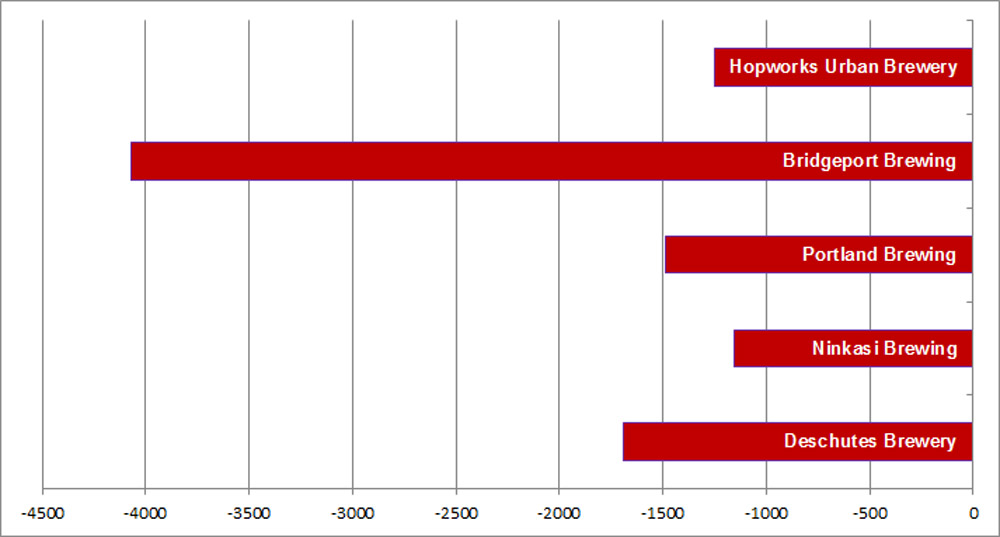
Now look at the chart below. These are the breweries showing the largest negative numbers over the same period. Three of the five are older, established breweries. The developing trend in Oregon is that younger, vibrant brands are taking share from long-established ones. Why? Likely because consumers, when they have a choice, prefer beer made in newer, typically smaller breweries.
The same trend appears to be gaining traction around the country. Small, local breweries are opening everywhere..the craft brewery count is now around 4,500. A lot of the new kids are taking share from established craft breweries, as well as from big beer. We are seeing this trend documented in IRI losses for older craft brands and big beer.
So why are craft growth numbers sluggish this year? Probably because small brewery volumes aren't being fully captured in IRI stats. Why? Because an increasing amount of beer is being sold in breweries or at growler fill stations, pubs, beer beers and others places outside IRI view. It will take improved data collection to see the full extent of what's happening.
For now, don't get too caught up in the notion that craft growth is faltering. A saturation point is coming. But we're not there, yet.
![]() |
| Oregon Barrel Volume Growth |
The craft segment is also underperforming, with single digit growth on the year. That wouldn't cause alarm if growth in recent years hadn't been in high double digits. When you're accustomed to year-over-year growth numbers like that, slower growth causes concern and, in some quarters, panic.
Despite the sluggish growth year, things probably aren't as dire for craft beer as some of us have been led to believe. We may be approaching saturation in some areas, but the overall health of the industry is pretty good.
The above chart shows some Oregon breweries that are doing quite well here. As with the negative numbers chart below, these are August 2015 to August 2016 OLCC numbers, provided by a helpful assistant who does quarterly spreadsheets. My disclaimer, as always, is that OLCC numbers are hopelessly incomplete and useful only as a guide to trends.
The list is comprised mostly of newer breweries formed within the last 10 years. These are brands that have flourished in recent times. Their beers have won awards and fans. Even 10 Barrel, which has unfair advantages over independent craft brewers, has produced some notable beers and continues to attract a following despite its ownership situation.
Now look at the chart below. These are the breweries showing the largest negative numbers over the same period. Three of the five are older, established breweries. The developing trend in Oregon is that younger, vibrant brands are taking share from long-established ones. Why? Likely because consumers, when they have a choice, prefer beer made in newer, typically smaller breweries.
![]() |
| Oregon Barrel Volume Decline |
So why are craft growth numbers sluggish this year? Probably because small brewery volumes aren't being fully captured in IRI stats. Why? Because an increasing amount of beer is being sold in breweries or at growler fill stations, pubs, beer beers and others places outside IRI view. It will take improved data collection to see the full extent of what's happening.
For now, don't get too caught up in the notion that craft growth is faltering. A saturation point is coming. But we're not there, yet.
Subscribe to:
Posts (Atom)