expr:class='"loading" + data:blog.mobileClass'>
Showing posts with label Great American Beer Festival. Show all posts

Monday, September 24, 2018

Oregon's GABF Connection, 2018

I didn't make the trip to Denver and the Great American Beer Festival this year. Last year was my first. I'll go again. Maybe next year. Regardless, it's always interesting to watch what transpires in the medal ceremony, some of which I watched via streaming. Surprises and trends.

If you're looking for summaries, look elsewhere. The complete results are posted on the GABF site and are sortable by state, beer, medal, etc. You can also find local and state coverage on The New School and Beervana blogs.

Surprises
The first surprise for me was Omission Pale Ale winning a gold medal in Classic English Style Pale Ale category. What's odd about it? Omission is a gluten-reduced beer winning in a standard category. The lager version of Omission won gold in a standard category two years ago, so maybe the Pale winning shouldn't be considered a giant surprise. Still.

Another surprise was MacTarnahan's Amber Ale winning silver the same category. This beer is ancient. I used to drink a lot of it back in the dark ages. I don't consider it a pale ale, but nevermind. MacTarnahan's has won before in this category, but not lately. I sampled a bottle of it earlier this year and it seemed pretty solid. Anyway, good news for Portland Brewing.

It wasn't a surprise, but it was good to see pFriem do well. The brewery won medals for its Pilsner and Druif, a mixed culture specialty beer. More importantly, perhaps, pFriem was named Mid Size Brewery of the Year. Anyone who's been to the pub in Hood River or had their beer in any form knows this award is well-deserved.

Finally, one of Oregon's prime medal suspects faltered this year. Breakside won four medals in 2017, three in 2016. It's IPA won a gold in 2014. But no medals this year. This despite the fact that the brewing program there appears to be as solid as ever. Go figure.

Medal Explosion
With the number of breweries across the country rising almost exponentially, GABF competition has has added new medal categories regularly. There were 160 total medals awarded in 2000. The number ballooned to 239 in 2010. This year, 306 medals were awarded.

It isn't that hard to figure out why. The brewery count is approaching 7,000. We have a growing number of styles and substyles represented in the marketplace. A good way to to keep everyone interested and focused is to increase the number of available medals. Viola!

Just over 2,400 breweries entered the beer competition this year. The only state not represented was Mississippi. We don't know the number of breweries per state. That's info the Brewers Association doesn't release in my experience. We do know that about 8,500 entries were evaluated by 239 judges from around the world. That's a crazy amount of beer to taste.

Oregon's Count
With the brewery count expanding everywhere, I wondered what might be happening to Oregon's share of the awarded medals at GABF. The website provides a handy way to look back at past years and determine how many total medals were awarded and how many Oregon won.

I took a look at the medal count every third year over the last 12 years Why 12? I don't know. It made sense for the task. I wanted to see if there was any kind of obvious trend without plotting every year. Anyway, I looked at 2018, 2015, 2012, 2009 and 2006.


You can see by way of the graphic what's happened. In 2018, Oregon won roughly 7 percent of  the awarded medals. That was about the same as 2015 and 2006, but down from the better than 9 percent won in 2009 and 2012.

Looking at every year 2006-2018, the lowest medal count was 11 in 2007. The highest was 25 in 2013. So Oregon breweries are winning an average of about 20 medals a year, while the number of awarded medals is increasing.

Is there any kind of notable trend? Not really. The medal count has bounced around a bit. I'm going to guess a rate of around 7 percent will begin to look like the new norm due to the growing number of breweries, better techniques and improved beer quality. But that's strictly a guess.

Just for fun, I looked at a few states that have seen significant increases in brewery count from where they were in 2006. Texas and Florida are in that boat. Between them, they won just four medals in 2006. This year, Texas and Florida combined to win 25 medals. Big change.

There's also California, which has more breweries (more than 900 by the end of 2017) than any other state and has always done well at GABF. California won 16 percent of the awarded GABF medals in 2009, 24 percent in 2015 and 23 percent in 2018...a case of the rich getting richer.

Portland's Count
Taking this exercise a step further, I looked at what's happened to Portland's share of Oregon medals over the same period. Portland has been a leader in the craft beer renaissance, but Oregon has a growing number of breweries (281 at the end of 2017) and a lot of them are winning GABF medals. What do the stats say?


The answer is that Portland's share of GABF medals appears to be in gradual decline. Portland brewers won 42 percent of the state's medals in 2006. This year, the share dropped to 31 percent. Similar numbers pop up for 2012 and 2015. The decline looks worse if you include 2003 (which I did in the graph), when Portland won 57 percent of the state's GABF medals.

Meaning
What does it all mean? It mostly means the craft revolution is expanding. The cities and states where the movement began and flourished have helped spread the word through the sharing of appropriate techniques and best practices. Craft beer is being assimilated.

The end result is that GABF medals are being won all over the country. Also known as good news for the industry.



Friday, October 13, 2017

Denver's House of Sky: GABF '17

Published in 1978, Ivan Doig's This House of Sky presents a memoir of his life growing up in the Big Sky country of Montana. I was reminded of the book title as I traipsed around Denver last weekend. Denver isn't Montana, obviously, but even in the downtown area, you have the sensation of a very broad horizon.


It took some time for me to fully absorb my experience at the Great American Beer Festival. I was warned upfront that the event is huge and unwieldy, so that part wasn't unexpected. But some aspects of the festival I didn't anticipate.

The Drinking
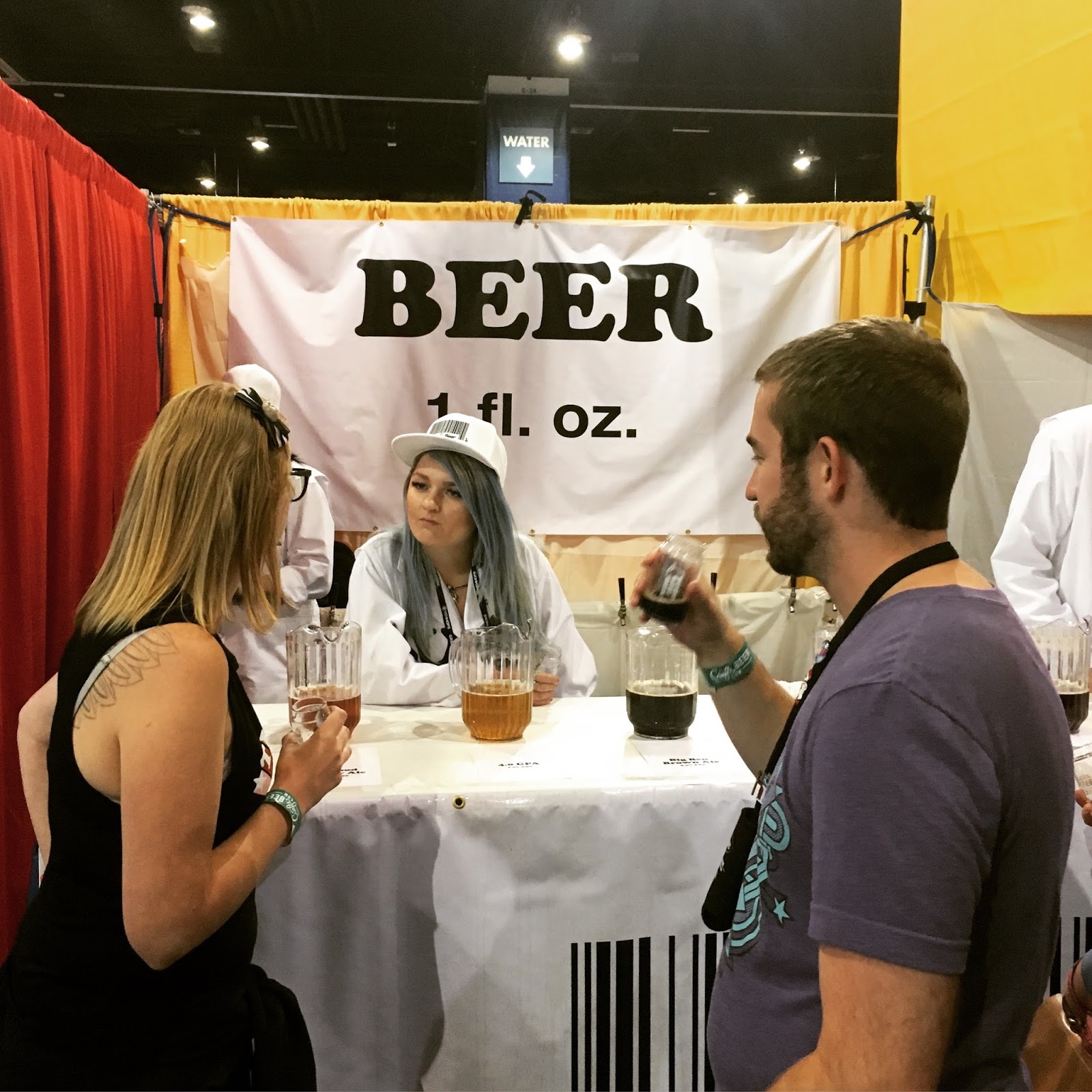
Having attended the Craft Brewers Conference in Portland a couple of  years ago, I figured GABF to be more of a giant trade show focused on beer than strictly a beer festival. I was correct. Although there was plenty of beer in the Convention Hall, there were also countless vendors showing off a variety of mostly beer-related wares. Trade show.

I attended Friday evening and Saturday afternoon drinking sessions. The Thursday evening session was out because I wasn't arriving in Denver until too late. My initial plan, on the advice of folks "in the know," was to attend only the early Saturday session. I wound up there Friday evening because I had nothing better to do.

In fact, the Friday session was less of a mess than Saturday afternoon. The crush of beer fans after the Saturday morning awards ceremony created near-gridlock conditions. Getting to medal winners or specific beers you wanted to taste often proved difficult due to congestion. There were just too many bodies in too little space, evidently not a new problem for this event.

What could they do to make it a little less of a shit show? It seems to me they either have to reduce the number of tickets sold or increase the amount of floor space. Because the layout isn't the problem. I do think it's unfortunate that there is very little sitting space, but that sort of fits with the GABF being more of a trade show than an actual festival.

The Awards
I wasn't sure what to expect at the Saturday morning awards ceremony. They eventually handed out medals in 99 style categories, plus the awards for breweries the year in several sizes. I'd watched the GABF awards before via streaming and still had no idea how they would handle the girth of the competition in a realistic amount of time.

Things got off to an awkward start when a large contingent of folks couldn't enter the ballroom because there wasn't enough seating. A number of these folks were hungover or still drunk from a night of imbibing. But never mind. Some stayed in the outer concourse, where the awards presentation could be seen on a screen. Others came in and stood or sat on the edges of the room. Not ideal.

The 99 categories have some redundancy. Follow this link and sort by style if you want to get a feel for that. It's over-the-top to me. But I get it. The Brewers Association wants to keep everyone interested even as the brewery count skyrockets. To do that, they spread the love by adding style categories. There were 12 in 1987, 34 in 1994, 70 in 2006. You get the idea.

It reminds me of my tournament racquetball career. In the old days, you played A, B, C, D or Open. Maybe there was a Masters division. Later, tournament directors added A/B, B/C and a hoard of age group divisions. More people got medals, which kept them playing and coming back. But tournaments became unmanageable. Craft beer appears headed down a similar path.


Navigate to the Beervana site if you want more detailed info on entries by state and winning percentages. There's no reason for me to redo or rethink what Jeff has already done. His piece is based on numbers the Brewers Association grudgingly provided and that were incomplete. There's a bizarre aura of secrecy permeating this organization, unfortunately.

Oregon's big winner was Sunriver Brewing, which collected gold medals for Cinder Beast Red and Fuzztail Hefeweizen, as well as Small Brewery of the Year. Breakside, as usual, entered the fray with four bronze medals, including a bigly one in the IPA category, which had 408 entries. Sort the winners list by state if you want the complete story.

The Miscalculations
When I received the invitation to apply for GABF media credentials, I didn't think much of it. Only after I gave it some thought did I decide to apply. After my application was approved, I had to decide if I would actually go. A credential only gets you into the festival. The main cost is getting and staying there. Is it worth it?

A friend and fellow writer advised me that he had been to GABF twice, which he figured was one time more than required. I laughed. But I hadn't been and always wanted to go, so I started looking at airfares and hotel rates. Shortly, travel arrangements were made; later I altered them so I would have two full days in Denver. That seemed about right.

There were misques. I didn't coordinate schedules with anyone and I wasn't staying close enough to the Convention Center to randomly join in. I hoped to enjoy some events outside the festival and maybe visit some breweries. Didn't happen. When you don't know your way around, you need to hook up with a group or have a specific plan of action. Significant whiffs on my part.

Of course, it likely didn't matter. The GABF crowd, the industry part of it, anyway, is considerably younger than me. Most places were routinely packed with kids. Although I don't have anything against them, I don't really fit in. That's become more and more apparent over the course of the past year for reasons I don't need to get into here. Nothing to do about it.

Would I return to GABF? Unlikely. If I did, it would only be as part of a group of like-minded folks staying in relatively the same area with plans to attend specific events and visit a list of places. The reality is, much of the action at GABF takes place outside the Convention Center. You need to set yourself up to experience at least some of that stuff.

Regardless of my experience, I have no problem recommending GABF to anyone who hasn't gone. Denver is a terrific city and the spectacle that is GABF is worth seeing. Once, if not twice. 🍻

Friday, October 12, 2012

Stenographers and Bubbles

It's a big week for craft beer. Some 50,000 beer fans have descended on Denver for the Great American Beer Festival. These fortunate folks will be sampling more than 2,700 beers from 578 breweries. The great bulk of the participating breweries are small. But make no mistake: craft beer is big business these days.

Corresponding with the GABF kickoff, there was a story on the CNBC website yesterday. The story, No Bubble for Craft Beer, is essentially an interview with Charlie Papazian, founder and president of the Brewers Association. Papazian talks about craft beer's rising star in recent years and flatly says there is "no [craft beer] bubble," despite concerns expressed by some in the industry.

Is there a craft beer bubble?
Look, I love that fact that we've seen the growth we've seen. There are more than 2,000 operating breweries in this country today, more than we've had since breweries were small and strictly local. The number of great beers out there continues to multiply. Terrific, right!

Still, I am increasingly uncomfortable with what passes for journalism in the digital age. We continue to see an erosion in the basic principle of objectivity. People with significant job titles or responsibilities are afforded a level of reverence that simply isn't in line with objective reporting. Journalists are stenographers.

In this case, what was Papazian supposed to say? Please recall this is a guy who virtually launched the craft beer movement in this country. Was he supposed to say the industry is at risk because recent growth has, in fact, been too rapid? Of course he wasn't going say that. Because saying so would be very bad PR.

Mid-2012 brewery count
And, yet, there it was. An article that presented one point of view...that of the person being interviewed. Perhaps the author might have considered digging a little deeper or talking to someone who is concerned that a bubble may be forming. What happened to objectivity?

Please understand, I don't always expect objectivity. I have friends who simply repost press releases and related promotional info on their blogs. They generally aren't getting paid for their effort. Even though I frankly think every press release should be evaluated, I have zero problem with citizen journalists whose blogs are primarily (and blindly) promotional.

That is not the case when it comes to supposedly reputable publications, whether online or traditional. People who get paid to function as journalists ought to be held to a higher standard.

Do I think there's a craft beer bubble forming? I'm not sure. But I hear a lot of brewers talking about it. Here's one question I would have asked Papazian or someone else had I been writing the story: "Are you concerned that even if there isn't a nationwide bubble, there may be bubbles forming in areas where the brewery count is especially high?"

Sadly, stenography is not journalism.